









- Sanitation systems
- Faecal sludge management (FSM)
- Faecal sludge transport (including emptying of pits and septic tanks, transfer stations)
- Manual pit emptying pump
Manual pit emptying pump
10 views

- BwanaChoo
-
 Topic Author
- I am a retired civil engineer specialising in sanitation and water supply and spent many years working in rural and peri-urban areas, mainly in Africa. Since my retirement I have continued to actively pursue my interest in faecal sludge management.
Less- Posts: 1
- Likes received: 0
Introducing the Gulper 4 manual sludge pump
This pump is intended to address some of the limitations of the Gulper pump, which has undergone several modifications during its
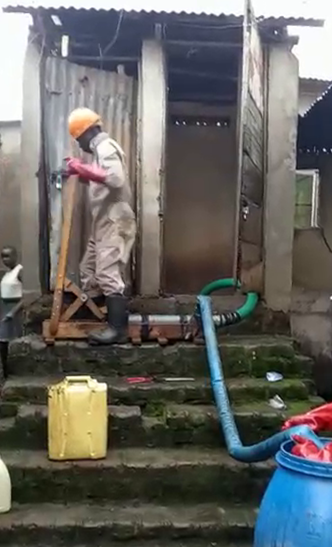
widespread use in Uganda. This new design became known as the Gulper 4 during field testing in Kampala and that seems to be as good a name as any. Like the original Gulper, it is a manually powered, portablepiston pump that is designed to be as simple as possible to facilitate local manufacture and to utilise commonly available materials and skills. Pump draws sludge from the pit or tank through a suction hose, and this overcomes the main problem with the original Gulper where the rigid pump cylinder is inserted into the pit. In many cases this involves partially dismantling of the latrine enclosure to insert the pump. In contrast locating the Gulper 4 in a convenient and safe place is far easier, and the range of depth of sludge that can be removed is generally greater.
The pump cylinder is arranged horizontally, which makes thepump more stable and the mechanism that transfers the rotational motion of the handle into a linear motion of the piston, may look complicated, but is in fact very simple. This arrangement also has the big advantage of having a mechanical advantage of approximately 3:1 (the handle moves three times further than the piston) making operation less physically demanding. The effort is also divided between the suction stroke that draws sludge into the pump and the delivery stroke that forces the sludge through the delivery hose to the destination that may be 10m or more away and several meters higher than the pump.
Construction
The basic frame and mechanism of the pump would usually bemade from wood, but other materials could be used. The pump itself consists largely of standard uPVC plumbing fittings and pipe, while the valves and piston seals are made from sheet rubber. While it may be possible to make a pump using only handtools, it will be far easier if you have access to a metal working lathe and a pillar drill.
Testing
There has been some field testing in several countries leading to several design refinements, that have improved performance. This has now
been followed up in an evaluation of various pump technologies in Rwanda, Uganda and Zambia. (see: file:///C:/Users/the_s/Downloads/201026_FSM-Action-Research-Project-Webinar-Z-1.pdf). Some pumps have been made in Uganda and one in Nepal. Pit emptying contractors in both Uganda and Rwanda are both interested in local manufacture and are convinced that there is a market for the pumps in their respective countries.
Drawings and Manual
Instructions for building a pump are given in an illustrated 50-page manual that also includes information on operation and maintenance. The 15 pages of construction drawings are available as pdf files that are designed to be printable at A4 size in black and white. Alternatively, you may contact me directly for CAD format drawings. You can make as many pumps as you wish and modify the designto suit your local requirement and available materials. All I ask is that you acknowledge me as the originator of the design. It would also be nice to
receive feedback on your experience with making and using the pump.
Conclusion
While the Gulper 4 is more complicated and costly than the originalGulper design, it will still be far cheaper to own and operate than any mechanically powered system. This will greatly expand the opportunities for small scale sanitation enterprises to improve their working conditions and productivity.
Contact details
You can contact me directly by email, telephone, WhatsApp or
Email: This email address is being protected from spambots. You need JavaScript enabled to view it.
Phone: +44 (0)7568687214
This pump is intended to address some of the limitations of the Gulper pump, which has undergone several modifications during its
widespread use in Uganda. This new design became known as the Gulper 4 during field testing in Kampala and that seems to be as good a name as any. Like the original Gulper, it is a manually powered, portablepiston pump that is designed to be as simple as possible to facilitate local manufacture and to utilise commonly available materials and skills. Pump draws sludge from the pit or tank through a suction hose, and this overcomes the main problem with the original Gulper where the rigid pump cylinder is inserted into the pit. In many cases this involves partially dismantling of the latrine enclosure to insert the pump. In contrast locating the Gulper 4 in a convenient and safe place is far easier, and the range of depth of sludge that can be removed is generally greater.
The pump cylinder is arranged horizontally, which makes thepump more stable and the mechanism that transfers the rotational motion of the handle into a linear motion of the piston, may look complicated, but is in fact very simple. This arrangement also has the big advantage of having a mechanical advantage of approximately 3:1 (the handle moves three times further than the piston) making operation less physically demanding. The effort is also divided between the suction stroke that draws sludge into the pump and the delivery stroke that forces the sludge through the delivery hose to the destination that may be 10m or more away and several meters higher than the pump.
Construction
The basic frame and mechanism of the pump would usually bemade from wood, but other materials could be used. The pump itself consists largely of standard uPVC plumbing fittings and pipe, while the valves and piston seals are made from sheet rubber. While it may be possible to make a pump using only handtools, it will be far easier if you have access to a metal working lathe and a pillar drill.
Testing
There has been some field testing in several countries leading to several design refinements, that have improved performance. This has now
been followed up in an evaluation of various pump technologies in Rwanda, Uganda and Zambia. (see: file:///C:/Users/the_s/Downloads/201026_FSM-Action-Research-Project-Webinar-Z-1.pdf). Some pumps have been made in Uganda and one in Nepal. Pit emptying contractors in both Uganda and Rwanda are both interested in local manufacture and are convinced that there is a market for the pumps in their respective countries.
Drawings and Manual
Instructions for building a pump are given in an illustrated 50-page manual that also includes information on operation and maintenance. The 15 pages of construction drawings are available as pdf files that are designed to be printable at A4 size in black and white. Alternatively, you may contact me directly for CAD format drawings. You can make as many pumps as you wish and modify the designto suit your local requirement and available materials. All I ask is that you acknowledge me as the originator of the design. It would also be nice to
receive feedback on your experience with making and using the pump.
Conclusion
While the Gulper 4 is more complicated and costly than the originalGulper design, it will still be far cheaper to own and operate than any mechanically powered system. This will greatly expand the opportunities for small scale sanitation enterprises to improve their working conditions and productivity.
Contact details
You can contact me directly by email, telephone, WhatsApp or
You do not have permissions to access this page.
You do not have permissions to access this page.
Signal as follows:Email: This email address is being protected from spambots. You need JavaScript enabled to view it.
Phone: +44 (0)7568687214
Jeff Broome
Attachments:
-
PrototypeK...23-2.png
(Filesize: 471KB)
Please Log in to join the conversation.
You need to login to reply
Share this thread:
- Sanitation systems
- Faecal sludge management (FSM)
- Faecal sludge transport (including emptying of pits and septic tanks, transfer stations)
- Manual pit emptying pump
Recently active users. Who else has been active?
Time to create page: 0.150 seconds