









- SuSanA working groups and regional chapters
- Working Group 9 (Public awareness, advocacy, civil society engagement)
- The PPE Paradox and Muster Roll Traps: A Reality Check from Rangpur City's Sanitation Workers
The PPE Paradox and Muster Roll Traps: A Reality Check from Rangpur City's Sanitation Workers
1118 views

- shakilWASH
-
 Topic Author
- Portfolio Manager (R&D), PEACE Consultancy(Research & Planning) Former City Coordinator, IUCN Former Urban Planner (Research Team member), SLE Berlin, Germany Former Technical Focal(WASH, CC), TIILER Specialist : #Climate Resilient Inclusive Smart City (CRISC) Planning and Development #Citywide Inclusive Sanitation Planning and Development #NBS
Less- Posts: 5
- Likes received: 2
The PPE Paradox and Muster Roll Traps: A Reality Check from Rangpur City's Sanitation Workers
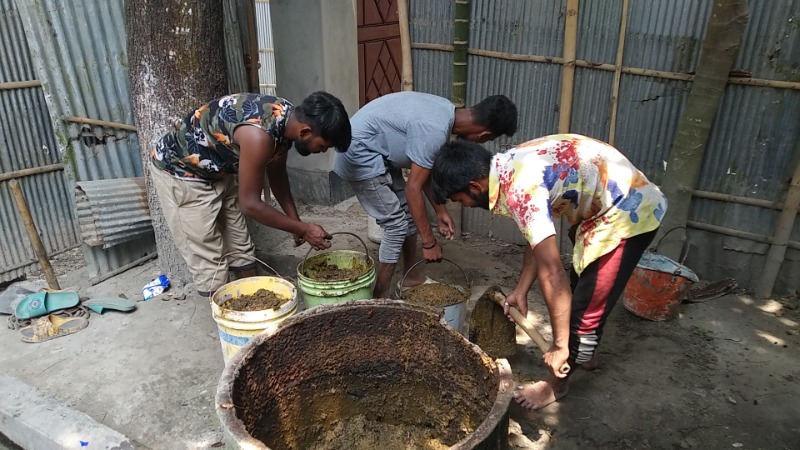
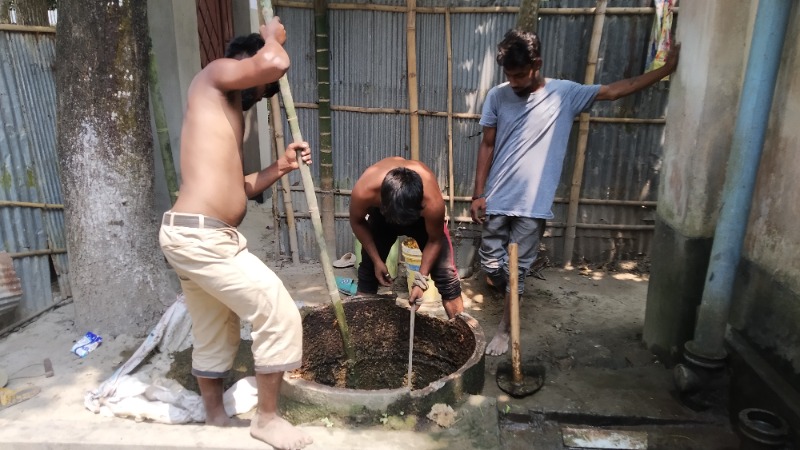
We talk a lot about Citywide Inclusive Sanitation (CWIS) and Occupational Health and Safety (OHS) in our strategic meetings. But when you actually sit down with the workers—both manual emptiers and vacuum tanker operators—you realize that our standard interventions are fundamentally misaligned with their daily realities.
I want to share three critical bottlenecks I’ve identified on the ground and open the floor to see how other cities or projects are tackling these issues.
1. The "PPE Paradox": We are giving them gear they can't use
The standard narrative is that workers lack PPE. But in Rangpur and Khulna, I found that many workers have received PPE and OHS training (some as recently as 2020). The problem is that standard PPE is entirely unsuited for our climate.
Abdul Malek, a vacuum tanker operator in Rangpur, told me:
Pranto Das in Khulna echoed this exact same sentiment. If the gear causes physical distress in 35°C heat, workers will naturally prioritize immediate physical comfort over long-term health. Are we wasting resources by distributing standard, heavy-duty PPE in tropical climates? What climate-adaptive, breathable PPE designs are actually working in South Asia?"I got twice OHS training and PPE in 2018 and 2020... But I don't feel comfortable to use PPE during work. It's made disturbance in work... it's made me warmer and over sweating most of the time except winter. So, I use PPE rarely if get pressure from authority."
2. The "Muster Roll" Trap: A 99% Informal Workforce
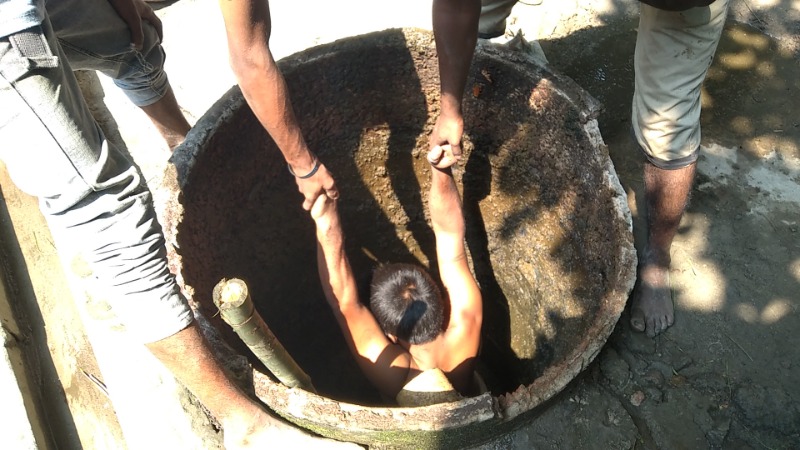
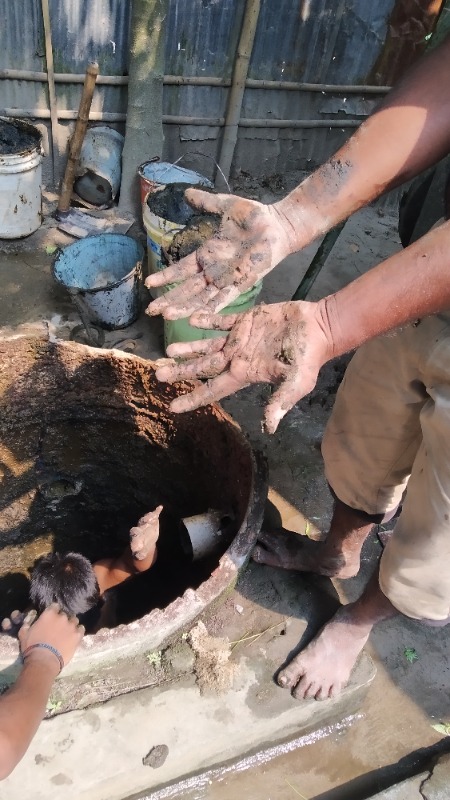
In Rangpur, about 99% of sanitation workers are employed informally under a "muster roll" system. They face a brutal "no work, no payment" policy. If they are injured or fall sick from handling fecal sludge barehanded, their pay is stopped.
Formal municipal workers earn around $150-$160/month with benefits. Muster roll workers like Abdul make just $80/month, and manual emptiers make even less. Because their base pay is below survival level, manual emptiers take deadly risks.
Mosal Basfor, a manual emptier in Rangpur with 12 years of experience, explained:
Without formalization, any OHS guidelines we introduce are essentially unenforceable suggestions. How are your projects successfully pushing local city corporations to formalize these workers?"Often, I enter into the pit and septic tank if household demand and pay extra... If we are injured at work, we will not be compensated for our injuries, and no one will take responsibility... We maintain a healthy environment in the city, but what do we get?"
3. The Dark Side of Mechanization (The "Just Transition" Gap)
We all champion mechanization—vacuum tankers over manual bucket-and-rope systems. But mechanization is destroying the livelihoods of traditional manual emptiers.
In Khulna, Gopal Das (25 years in the profession) shared a heartbreaking reality:
We are saving them from health hazards, but pushing them into extreme poverty and child labor. When city corporations introduce vacuum trucks, what policies are being put in place to absorb manual emptiers into the new system (e.g., as drivers, helpers, or maintenance staff)?"We are suffering extreme poverty at present due to introducing Vacuum Tanker Emptying service. We are unemployed day by day... My younger son at age 14 among 3 children. He goes with me and help my work. I won't able to send for primary education."
Looking Forward
The stigma is so deep that workers like Abdul hide their professions from their neighbors and work only at night to avoid public teasing.
As someone working on Climate Resilient Inclusive Smart City (CRISC) planning, I believe Rangpur City Corporation needs to:
- Procure climate-adaptive, lightweight PPE.
- Abolish the muster roll and formalize the workforce with living wages.
- Enforce the use of gas detectors before any confined space entry.
- Create a "Just Transition" policy for manual emptiers displaced by mechanization.
Portfolio Manager (R&D),
PEACE Consultancy(Research & Planning)
Former City Coordinator, IUCN
Former Urban Planner (Research Team member),
SLE Berlin, Germany
Former Technical Focal(WASH, CC), TIILER
Specialist :
#Climate Resilient Inclusive Smart City (CRISC) Planning and Development
#Citywide Inclusive Sanitation Planning and Development
#Circular Economy Model
#Nature-Based Solution
Email: This email address is being protected from spambots. You need JavaScript enabled to view it.
This email address is being protected from spambots. You need JavaScript enabled to view it.
Cell: +8801744976369
Attachments:
-
 IMG_202304...8-03.jpg
(Filesize: 138KB)
IMG_202304...8-03.jpg
(Filesize: 138KB)
-
 IMG_202304...8-03.jpg
(Filesize: 128KB)
IMG_202304...8-03.jpg
(Filesize: 128KB)
-
 IMG_202304...8-03.jpg
(Filesize: 120KB)
IMG_202304...8-03.jpg
(Filesize: 120KB)
-
 IMG_202304...8-03.jpg
(Filesize: 136KB)
IMG_202304...8-03.jpg
(Filesize: 136KB)
Please Log in to join the conversation.
You need to login to reply- SuSanA working groups and regional chapters
- Working Group 9 (Public awareness, advocacy, civil society engagement)
- The PPE Paradox and Muster Roll Traps: A Reality Check from Rangpur City's Sanitation Workers