









- Health and hygiene, schools and other non-household settings
- Health issues and connections with sanitation
- Ending cholera a global road map by 2030
Ending cholera a global road map by 2030
1606 views

- Kapaluseleji
-
 Topic Author
- Environmental health technologist
Less- Posts: 18
- Likes received: 6

Cholera, once eliminated from the Global North more than a century ago, remains a devastating disease for the world's poorest communities. Today, 47 countries continue to face recurrent outbreaks, contributing to an estimated 2.86 million cases and 95,000 deaths each year. Cholera thrives where poverty, conflict, weak health systems, unsafe water, and poor sanitation intersect, making it both a disease and a marker of deep social inequity.
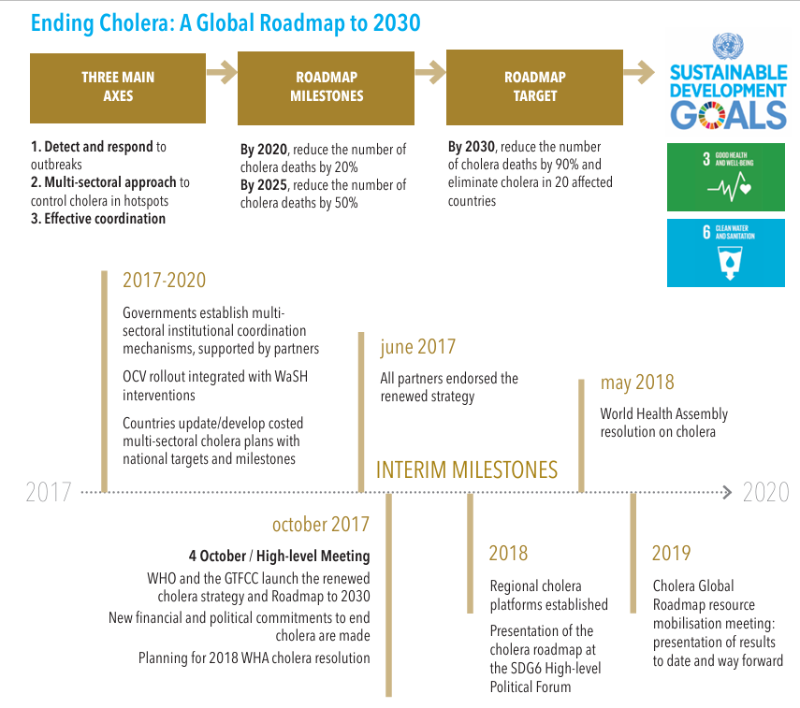
To change this trajectory, the Global Task Force on Cholera Control (GTFCC) launched Ending Cholera: A Global Roadmap to 2030, an ambitious strategy aiming to cut cholera deaths by 90% and eliminate the disease in at least 20 countries. The Roadmap links cholera control with the Sustainable Development Goals by emphasizing long-term investments in water, sanitation, and hygiene (WASH), alongside strong surveillance and rapid outbreak response.
The strategy is built on three pillars: early detection and swift containment of outbreaks, targeted multisectoral interventions in high-risk hotspots, and a robust coordination mechanism for technical support, capacity building, research, and resource mobilization. High-quality data is central to this approach, enabling countries to quickly confirm cases, identify hotspots, and guide interventions where they are needed most.
Evidence shows that focusing on cholera hotspots, often the poorest and most underserved areas, can dramatically reduce national and regional disease burdens. In sub-Saharan Africa, targeting just 4% of the population living in the highest-risk districts could cut the region's cholera burden by half. Investments in basic WASH services, which may cost as little as $40 per person over 10 years, have the potential not only to prevent cholera but to curb other waterborne diseases and advance progress toward multiple SDGs.
The availability of oral cholera vaccines (OCVs), improved diagnostic tools, and growing political commitment have made cholera elimination more feasible than ever before. OCVs offer immediate protection for 2-3 years, buying time for countries to implement long-term WASH solutions and strengthen health systems.
Cholera is entirely preventable with today's tools. With sustained commitment, coordinated action, and strategic investments, the world can realistically achieve a 90% reduction in cholera deaths by 2030, delivering health, dignity, and opportunity to the communities that need it most.
To change this trajectory, the Global Task Force on Cholera Control (GTFCC) launched Ending Cholera: A Global Roadmap to 2030, an ambitious strategy aiming to cut cholera deaths by 90% and eliminate the disease in at least 20 countries. The Roadmap links cholera control with the Sustainable Development Goals by emphasizing long-term investments in water, sanitation, and hygiene (WASH), alongside strong surveillance and rapid outbreak response.
The strategy is built on three pillars: early detection and swift containment of outbreaks, targeted multisectoral interventions in high-risk hotspots, and a robust coordination mechanism for technical support, capacity building, research, and resource mobilization. High-quality data is central to this approach, enabling countries to quickly confirm cases, identify hotspots, and guide interventions where they are needed most.
Evidence shows that focusing on cholera hotspots, often the poorest and most underserved areas, can dramatically reduce national and regional disease burdens. In sub-Saharan Africa, targeting just 4% of the population living in the highest-risk districts could cut the region's cholera burden by half. Investments in basic WASH services, which may cost as little as $40 per person over 10 years, have the potential not only to prevent cholera but to curb other waterborne diseases and advance progress toward multiple SDGs.
The availability of oral cholera vaccines (OCVs), improved diagnostic tools, and growing political commitment have made cholera elimination more feasible than ever before. OCVs offer immediate protection for 2-3 years, buying time for countries to implement long-term WASH solutions and strengthen health systems.
Cholera is entirely preventable with today's tools. With sustained commitment, coordinated action, and strategic investments, the world can realistically achieve a 90% reduction in cholera deaths by 2030, delivering health, dignity, and opportunity to the communities that need it most.
Environmental health technologist 🦺
K.seleji
K.seleji
Attachments:
-
 IMG_6996.png
(Filesize: 225KB)
IMG_6996.png
(Filesize: 225KB)
Please Log in to join the conversation.
You need to login to reply
Share this thread:
- Health and hygiene, schools and other non-household settings
- Health issues and connections with sanitation
- Ending cholera a global road map by 2030
Recently active users. Who else has been active?
Time to create page: 0.126 seconds