









- Forum
- categories
- Equity, inclusion and sanitation workers
- Sanitation workers
- Equity, dignity, caste and gender aspects for sanitation workers
- The Garima Story: Sanitation Work with Safety and Dignity in Urban Odisha
The Garima Story: Sanitation Work with Safety and Dignity in Urban Odisha
4684 views


Re: The Garima Story: Sanitation Work with Safety and Dignity in Urban Odisha
Dear Mary,
Thank you for your thoughtful comments and for sharing the context from Zambia.One of the key lessons from the Garima Programme has been that improving sanitation worker safety requires a combination of policy commitment, institutional systems, capacity building, and continuous engagement with workers themselves. The programme continues to evolve through the experiences and feedback of sanitation workers across Odisha.We agree that many sanitation workers around the world continue to face unsafe and challenging working conditions. Platforms such as SuSanA provide valuable opportunities to learn from one another and exchange practical approaches for improving worker safety, dignity, and social protection.We would be very interested to learn more about initiatives and experiences from Zambia related to sanitation worker welfare and occupational safety.Thank you again for engaging with the publication.Kind regards,
Meghna
Thank you for your thoughtful comments and for sharing the context from Zambia.One of the key lessons from the Garima Programme has been that improving sanitation worker safety requires a combination of policy commitment, institutional systems, capacity building, and continuous engagement with workers themselves. The programme continues to evolve through the experiences and feedback of sanitation workers across Odisha.We agree that many sanitation workers around the world continue to face unsafe and challenging working conditions. Platforms such as SuSanA provide valuable opportunities to learn from one another and exchange practical approaches for improving worker safety, dignity, and social protection.We would be very interested to learn more about initiatives and experiences from Zambia related to sanitation worker welfare and occupational safety.Thank you again for engaging with the publication.Kind regards,
Meghna
Meghna Malhotra
Deputy Director, Urban Management Centre (UMC) – Ahmedabad, India
Urban Management Centre (UMC) is a not-for-profit organisation working with national and state governments to build capacities for inclusive and resilient urban governance.
Over the past decade, UMC has supported transformative sanitation initiatives such as:
• Garima (Odisha) – ensuring safety, dignity, and inclusion of sanitation workers
• Sanitation Workers Development Scheme (Tamil Nadu) – institutionalising welfare systems
• NAMASTE – supporting the national mission for sanitation worker empowerment
• City Livelihoods Action Plans (CLAP) – integrating urban livelihoods and gender inclusion
Visit: www.umcasia.org
Follow us: LinkedIn – Urban Management Centre
Deputy Director, Urban Management Centre (UMC) – Ahmedabad, India
Urban Management Centre (UMC) is a not-for-profit organisation working with national and state governments to build capacities for inclusive and resilient urban governance.
Over the past decade, UMC has supported transformative sanitation initiatives such as:
• Garima (Odisha) – ensuring safety, dignity, and inclusion of sanitation workers
• Sanitation Workers Development Scheme (Tamil Nadu) – institutionalising welfare systems
• NAMASTE – supporting the national mission for sanitation worker empowerment
• City Livelihoods Action Plans (CLAP) – integrating urban livelihoods and gender inclusion
Visit: www.umcasia.org
Follow us: LinkedIn – Urban Management Centre
Please Log in to join the conversation.
You need to login to reply- MaryMwenya
-
 Less
Less- Posts: 11
- Likes received: 4
Re: The Garima Story: Sanitation Work with Safety and Dignity in Urban Odisha
Dear Meghna,
The Garima Programme is truly inspiring. It’s amazing to see how sanitation work can be done with dignity, safety, and real support for the workers. Things like training, social protection, and emergency response units show what’s possible when people are put first.
In Zambia, many sanitation workers face tough and unsafe conditions every day. Programs like Garima give us real ideas on how we could do better protecting workers, valuing their skills, and making sanitation work sustainable for everyone.
Regards
Mary
The Garima Programme is truly inspiring. It’s amazing to see how sanitation work can be done with dignity, safety, and real support for the workers. Things like training, social protection, and emergency response units show what’s possible when people are put first.
In Zambia, many sanitation workers face tough and unsafe conditions every day. Programs like Garima give us real ideas on how we could do better protecting workers, valuing their skills, and making sanitation work sustainable for everyone.
Regards
Mary
The following user(s) like this post: meghna
Please Log in to join the conversation.
You need to login to replyThe Garima Story: Sanitation Work with Safety and Dignity in Urban Odisha
The Garima Story: Sanitation Work with Safety and Dignity in Urban Odisha
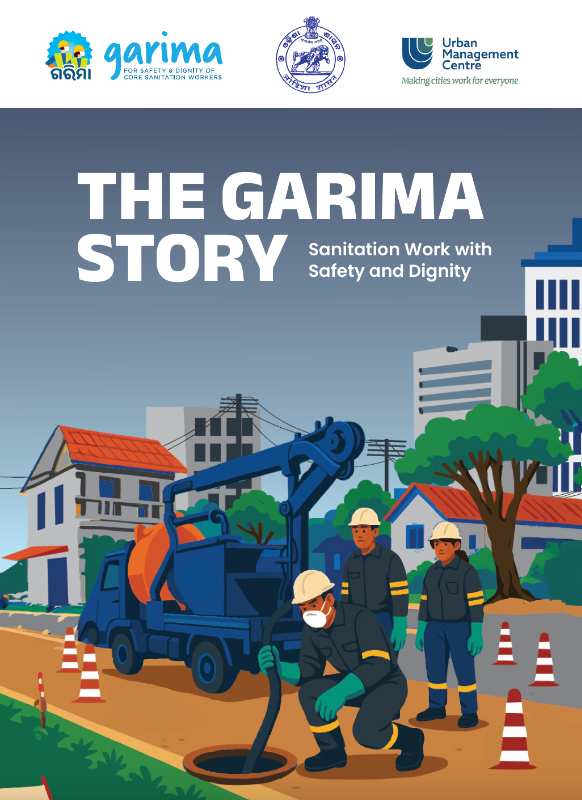
The Garima Story, jointly published by the Government of Odisha’s Housing and Urban Development Department (H&UDD) and the Urban Management Centre (UMC), chronicles Odisha’s pioneering Garima Programme—India’s first comprehensive, state-wide initiative to ensure the safety, dignity, and inclusion of sanitation workers.
About the publication:
Launched in 2020, the Garima Programme redefined how sanitation work is governed and valued in India. Implemented across all 115 Urban Local Bodies (ULBs) in Odisha, it institutionalised systems that protect workers’ lives and livelihoods through structured reforms—ranging from enumeration and welfare entitlements to mechanisation and occupational health.
What it covers:
• The context of sanitation worker invisibility and the Garima vision for systemic reform
• Institutional frameworks and convergence across government departments
• Use of digital tools like Quneiform for worker enumeration, validation, and entitlement mapping
• Establishment of Emergency Response Sanitation Units (ERSUs) in every ULB
• Sewer Entry Professional (SEP) training for skill certification and safe practices
• Occupational health, insurance, and social security mechanisms under Garima
• Field stories that highlight the human impact of policy-driven dignity
Why it matters:
Garima demonstrates how an Indian state can transform sanitation work through empathy, innovation, and institutional collaboration. Its governance architecture and human-centred design offer a replicable model for inclusive sanitation reform—aligning with SDG 6 (Clean Water & Sanitation), SDG 8 (Decent Work & Economic Growth), and SDG 10 (Reduced Inequalities).
📘 Read the full publication here
📅 Published: August 2025 | © Government of Odisha & Urban Management Centre
Supported by: Bill & Melinda Gates Foundation
We invite SuSanA members to share comparable experiences of sanitation worker welfare programmes, occupational safety reforms, or data-driven inclusion initiatives from their countries.
— *Meghna Malhotra*
Deputy Director, Urban Management Centre (UMC), India
The Garima Story, jointly published by the Government of Odisha’s Housing and Urban Development Department (H&UDD) and the Urban Management Centre (UMC), chronicles Odisha’s pioneering Garima Programme—India’s first comprehensive, state-wide initiative to ensure the safety, dignity, and inclusion of sanitation workers.
About the publication:
Launched in 2020, the Garima Programme redefined how sanitation work is governed and valued in India. Implemented across all 115 Urban Local Bodies (ULBs) in Odisha, it institutionalised systems that protect workers’ lives and livelihoods through structured reforms—ranging from enumeration and welfare entitlements to mechanisation and occupational health.
What it covers:
• The context of sanitation worker invisibility and the Garima vision for systemic reform
• Institutional frameworks and convergence across government departments
• Use of digital tools like Quneiform for worker enumeration, validation, and entitlement mapping
• Establishment of Emergency Response Sanitation Units (ERSUs) in every ULB
• Sewer Entry Professional (SEP) training for skill certification and safe practices
• Occupational health, insurance, and social security mechanisms under Garima
• Field stories that highlight the human impact of policy-driven dignity
Why it matters:
Garima demonstrates how an Indian state can transform sanitation work through empathy, innovation, and institutional collaboration. Its governance architecture and human-centred design offer a replicable model for inclusive sanitation reform—aligning with SDG 6 (Clean Water & Sanitation), SDG 8 (Decent Work & Economic Growth), and SDG 10 (Reduced Inequalities).
📘 Read the full publication here
📅 Published: August 2025 | © Government of Odisha & Urban Management Centre
Supported by: Bill & Melinda Gates Foundation
We invite SuSanA members to share comparable experiences of sanitation worker welfare programmes, occupational safety reforms, or data-driven inclusion initiatives from their countries.
— *Meghna Malhotra*
Deputy Director, Urban Management Centre (UMC), India
Meghna Malhotra
Deputy Director, Urban Management Centre (UMC) – Ahmedabad, India
Urban Management Centre (UMC) is a not-for-profit organisation working with national and state governments to build capacities for inclusive and resilient urban governance.
Over the past decade, UMC has supported transformative sanitation initiatives such as:
• Garima (Odisha) – ensuring safety, dignity, and inclusion of sanitation workers
• Sanitation Workers Development Scheme (Tamil Nadu) – institutionalising welfare systems
• NAMASTE – supporting the national mission for sanitation worker empowerment
• City Livelihoods Action Plans (CLAP) – integrating urban livelihoods and gender inclusion
Visit: www.umcasia.org
Follow us: LinkedIn – Urban Management Centre
Deputy Director, Urban Management Centre (UMC) – Ahmedabad, India
Urban Management Centre (UMC) is a not-for-profit organisation working with national and state governments to build capacities for inclusive and resilient urban governance.
Over the past decade, UMC has supported transformative sanitation initiatives such as:
• Garima (Odisha) – ensuring safety, dignity, and inclusion of sanitation workers
• Sanitation Workers Development Scheme (Tamil Nadu) – institutionalising welfare systems
• NAMASTE – supporting the national mission for sanitation worker empowerment
• City Livelihoods Action Plans (CLAP) – integrating urban livelihoods and gender inclusion
Visit: www.umcasia.org
Follow us: LinkedIn – Urban Management Centre
Attachments:
-
 TheGarimaS...page.png
(Filesize: 394KB)
TheGarimaS...page.png
(Filesize: 394KB)
The following user(s) like this post: paresh, MaryMwenya
Please Log in to join the conversation.
You need to login to reply
Share this thread:
- Forum
- categories
- Equity, inclusion and sanitation workers
- Sanitation workers
- Equity, dignity, caste and gender aspects for sanitation workers
- The Garima Story: Sanitation Work with Safety and Dignity in Urban Odisha
Recently active users. Who else has been active?
Time to create page: 0.139 seconds