









- Forum
- categories
- Equity, inclusion and sanitation workers
- Sanitation workers
- Equity, dignity, caste and gender aspects for sanitation workers
- Integrating Women’s Self-Help Groups into Urban Sanitation Service Delivery in India
Integrating Women’s Self-Help Groups into Urban Sanitation Service Delivery in India
5433 views


Re: Integrating Women’s Self-Help Groups into Urban Sanitation Service Delivery in India
Dear Mary,Thank you for your kind words and for taking the time to engage with the publication.One of the important lessons from our work has been that sanitation systems become more sustainable and inclusive when communities are active partners in service delivery. Women's Self-Help Groups have demonstrated remarkable leadership in managing services, strengthening accountability, and creating livelihood opportunities while contributing to improved sanitation outcomes.We have also seen that linking SHGs with municipal systems and long-term institutional support can help move beyond short-term projects towards more resilient and community-owned models.We appreciate your encouragement and would be interested to learn whether similar community-based approaches are being explored in Zambia or elsewhere in your region.Thank you again for contributing to the discussion.
Kind regards,Meghna
Kind regards,Meghna
Meghna Malhotra
Deputy Director, Urban Management Centre (UMC) – Ahmedabad, India
Urban Management Centre (UMC) is a not-for-profit organisation working with national and state governments to build capacities for inclusive and resilient urban governance.
Over the past decade, UMC has supported transformative sanitation initiatives such as:
• Garima (Odisha) – ensuring safety, dignity, and inclusion of sanitation workers
• Sanitation Workers Development Scheme (Tamil Nadu) – institutionalising welfare systems
• NAMASTE – supporting the national mission for sanitation worker empowerment
• City Livelihoods Action Plans (CLAP) – integrating urban livelihoods and gender inclusion
Visit: www.umcasia.org
Follow us: LinkedIn – Urban Management Centre
Deputy Director, Urban Management Centre (UMC) – Ahmedabad, India
Urban Management Centre (UMC) is a not-for-profit organisation working with national and state governments to build capacities for inclusive and resilient urban governance.
Over the past decade, UMC has supported transformative sanitation initiatives such as:
• Garima (Odisha) – ensuring safety, dignity, and inclusion of sanitation workers
• Sanitation Workers Development Scheme (Tamil Nadu) – institutionalising welfare systems
• NAMASTE – supporting the national mission for sanitation worker empowerment
• City Livelihoods Action Plans (CLAP) – integrating urban livelihoods and gender inclusion
Visit: www.umcasia.org
Follow us: LinkedIn – Urban Management Centre
Please Log in to join the conversation.
You need to login to reply- MaryMwenya
-
 Less
Less- Posts: 11
- Likes received: 4
Re: Integrating Women’s Self-Help Groups into Urban Sanitation Service Delivery in India
Dear ,Director
Great post on integrating women in self help Groups into urban Sanitation service delivery ,your work with UMC shows how linking SHGs with municipal contracts can boost community ownership and give women dignified livelihoods. This initiative is truly inspiring and making communities more inclusive .
Regards
mary
Great post on integrating women in self help Groups into urban Sanitation service delivery ,your work with UMC shows how linking SHGs with municipal contracts can boost community ownership and give women dignified livelihoods. This initiative is truly inspiring and making communities more inclusive .
Regards
mary
The following user(s) like this post: meghna
Please Log in to join the conversation.
You need to login to replyIntegrating Women’s Self-Help Groups into Urban Sanitation Service Delivery in India
Integrating Women’s Self-Help Groups into Urban Sanitation Service Delivery in India
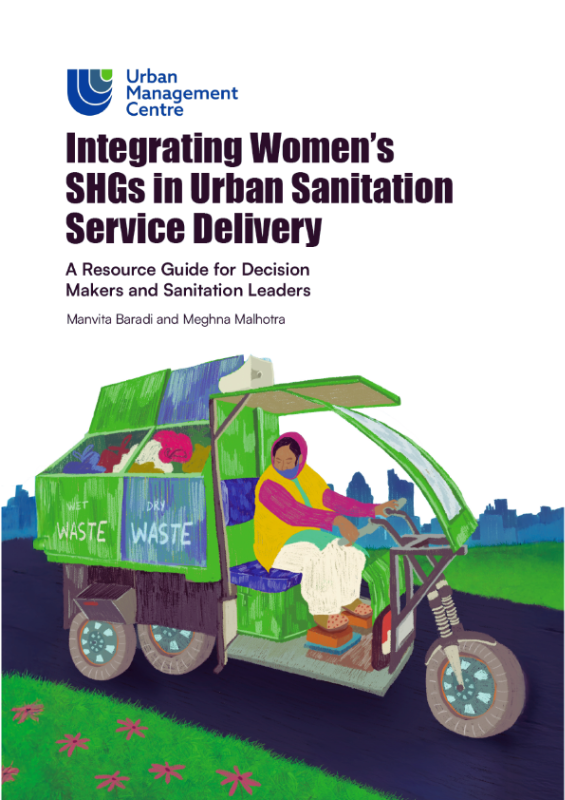
In many Indian cities, Women’s Self-Help Groups (SHGs) have played a transformative role in improving sanitation outcomes while creating dignified livelihood opportunities for women. The Urban Management Centre (UMC), through its technical support to state and city governments, has developed approaches that integrate SHGs into solid waste and sanitation service delivery — strengthening both community participation and gender inclusion.
This publication, developed under UMC’s ongoing work with municipal administrations, documents successful cases from Odisha, Gujarat, and Madhya Pradesh. It highlights how women’s collectives are being formally engaged in sanitation value chains such as:
• Door-to-door waste collection and segregation
• Toilet maintenance and community cleaning
• Fecal sludge management and micro-enterprise operations
• Awareness generation on hygiene and source segregation
Key learnings:
• Linking SHGs with municipal contracts increases reliability and ownership in service delivery.
• Providing institutional and financial handholding helps sustain women-led enterprises.
• Integrating livelihoods with sanitation governance advances SDG 5 and SDG 6 commitments.
📘 Read the full publication here .
We invite practitioners and local governments to share similar experiences of women’s collectives in sanitation and discuss opportunities for scaling such models across regions.
— Meghna Malhotra
Deputy Director, Urban Management Centre (UMC), India
In many Indian cities, Women’s Self-Help Groups (SHGs) have played a transformative role in improving sanitation outcomes while creating dignified livelihood opportunities for women. The Urban Management Centre (UMC), through its technical support to state and city governments, has developed approaches that integrate SHGs into solid waste and sanitation service delivery — strengthening both community participation and gender inclusion.
This publication, developed under UMC’s ongoing work with municipal administrations, documents successful cases from Odisha, Gujarat, and Madhya Pradesh. It highlights how women’s collectives are being formally engaged in sanitation value chains such as:
• Door-to-door waste collection and segregation
• Toilet maintenance and community cleaning
• Fecal sludge management and micro-enterprise operations
• Awareness generation on hygiene and source segregation
Key learnings:
• Linking SHGs with municipal contracts increases reliability and ownership in service delivery.
• Providing institutional and financial handholding helps sustain women-led enterprises.
• Integrating livelihoods with sanitation governance advances SDG 5 and SDG 6 commitments.
📘 Read the full publication here .
We invite practitioners and local governments to share similar experiences of women’s collectives in sanitation and discuss opportunities for scaling such models across regions.
— Meghna Malhotra
Deputy Director, Urban Management Centre (UMC), India
Meghna Malhotra
Deputy Director, Urban Management Centre (UMC) – Ahmedabad, India
Urban Management Centre (UMC) is a not-for-profit organisation working with national and state governments to build capacities for inclusive and resilient urban governance.
Over the past decade, UMC has supported transformative sanitation initiatives such as:
• Garima (Odisha) – ensuring safety, dignity, and inclusion of sanitation workers
• Sanitation Workers Development Scheme (Tamil Nadu) – institutionalising welfare systems
• NAMASTE – supporting the national mission for sanitation worker empowerment
• City Livelihoods Action Plans (CLAP) – integrating urban livelihoods and gender inclusion
Visit: www.umcasia.org
Follow us: LinkedIn – Urban Management Centre
Deputy Director, Urban Management Centre (UMC) – Ahmedabad, India
Urban Management Centre (UMC) is a not-for-profit organisation working with national and state governments to build capacities for inclusive and resilient urban governance.
Over the past decade, UMC has supported transformative sanitation initiatives such as:
• Garima (Odisha) – ensuring safety, dignity, and inclusion of sanitation workers
• Sanitation Workers Development Scheme (Tamil Nadu) – institutionalising welfare systems
• NAMASTE – supporting the national mission for sanitation worker empowerment
• City Livelihoods Action Plans (CLAP) – integrating urban livelihoods and gender inclusion
Visit: www.umcasia.org
Follow us: LinkedIn – Urban Management Centre
Attachments:
-
 Publicatio...very.png
(Filesize: 499KB)
Publicatio...very.png
(Filesize: 499KB)
Please Log in to join the conversation.
You need to login to reply
Share this thread:
- Forum
- categories
- Equity, inclusion and sanitation workers
- Sanitation workers
- Equity, dignity, caste and gender aspects for sanitation workers
- Integrating Women’s Self-Help Groups into Urban Sanitation Service Delivery in India
Recently active users. Who else has been active?
Time to create page: 0.159 seconds