









- Forum
- categories
- Sanitation systems
- Toilets without urine diversion
- Comparisons of various toilet types
- Are pour flush toilets a good idea for (South) Africa?
Are pour flush toilets a good idea for (South) Africa?
68.4k views


Thanks for your post. There is definitely no silver bullet - one solution for everybody. If people are keen on UDDT I think it's great.
However pour flush does not need clean water - grey water is fine - so if people have enough for washing they should have enough for flushing. You can also combine UD and pour flush to get what I believe they are now calling "wet ecosan".
Incidentally two of our pour lfush trial units have been built in places where it turns out the summer water table is very high (20 cm from the surface). These are being closely monitored for groundwater effects, and so far the effect is very local. The high water table has not prevented the pour flush from working, but we are watching them with interest.
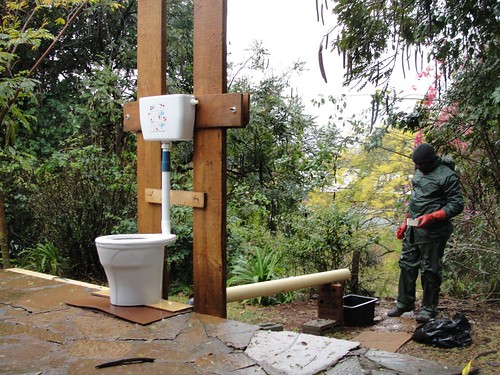
Testing low flush pour flush adaptation at PID by Sustainable sanitation , on Flickr
Dave
Please Log in to join the conversation.
You need to login to reply
My point of view is that waterless toilet is always better than water toilet.
I think that we have to think differently. We do not have to use water for the toilet when it is possible. Water toilet always include treatment and pollution problems. I understand that my point of view in the one of a rich man in a rich country but using water in toilets is also a european vision and a rich vision.
I am sure that if we all work together, we can find a waterless solutions for all the cases.
I am also sure that the whole price of a waterless toilet is lower than water toilet one (if we take into account the treatment cost and and cost of disease due to water pollution)
I am dreaming I know but it is pleasant.
Regards
Emmanuel
Ecodomeo
Ecodomeo - France
www.ecodomeo.com
Please Log in to join the conversation.
You need to login to reply
Elisabeth….interesting point… I did not know that pour flush in Africa are not common. In Latin America they are called “letrina de arrastre hidraulico” and they are common in some areas (parts of countries). I think pour flush is the only solution besides UDDT which offers the same quality in use as a “standard toilet”, due to the aspects Elisabeth mentioned. But just looking from a technical point of view I think three technical negative points are crucial to evaluated:
• There is a need for water…Elisabeth pointed out that it is not much, but for areas with shortage this is a problem
• They are not suitable in high water table areas as there will be direct groundwater contamination or problems with infiltration.
• They are not suitable or in areas with low infiltration capacity as they will overflow.
You might argue … “ok, these are technical arguments which have to be taken into account in building”. For me that is the question with almost all onsite sanitation systems. To what extent the technical knowledge is present in a process of choosing the technology…for my house… the house owners normally do not have that knowledge and they might overestimate the infiltration capacity or might not understand the problem of a high water table (as most pit owners).
We had an interesting experience in Peru. In the region of Cusco pour flush toilets are quite well known and well installed and well used. The regional government is using them as their favorite technology. In a small village with strong water shortage and difficult infiltration situation we were asked if we wanted to offer the possibility to install UDDTs for interested families. We were reluctant as we did not want to impose a system, nor compete (negatively) with an also good system, so we offered in parallel the possibility to install a UDDT (double vault bench). Both systems had almost the same conditions of financing. Of 30 families, half opted for pour flush and half for UDDT. We did the UDDT (with help of the regional government), the pour flush were done by the regional government. Both systems were well accepted and used. After a year a follow up by the social service of the regional government, showed that a large part of the pour flush users were reluctant that they choose their system, as there have been severe water shortages during the year and some of the pits were already full.
My lesson… to me the advantage was clear from the beginning … and I repeat with good infiltration conditions and water available pour flush is a very good option …. How can we prevent this situation for the users? Without imposing…when does imposing start and where does technical advice end?
Just personally – I do prefer UDDT (double vault). They are suitable in all situations, I just have to get installation right (especially the urine drainage), this I can acchieve by training the professional who does the installation.
To Dave:
I really appreciate the comments
Where on-site sanitation, be it pit latrines, pour flush latrines or full flush with septic tanks, serve low density communities who are not using the local groundwater for their drinking water, there really is no public health risk that I can see. It is certainly a great deal better than no sanitation and more sustainable than full waterborne sanitation.
I do see this as a mayor problem in very many systems here in Latin America. The sewer system creates an intensive pollution point source, instead of broad soil infiltration points which eliminate large part of the contamination. Especially in areas where there are no shallow bore holes this is a very, very important overseen aspect to sanitation quality. The large investment and all the hazzle of building a treatment plant (if it is build) do result in worse water body quality as the plant operation often fails, a very sad situation.Twenty years of comprehensive monitoring of E coli in these rivers by our water authorities proves conclusively that the greatest environmental threat to these rivers is created by dysfunctional sewage systems. Our rivers are far more polluted below sewered areas than they are below unsewered areas with on-site sanitation.
As we promote urine infiltration for UDDT (when no use intended) we are often critically asked, especially from donor organizations, about the contamination with nitrate... even seriously questioned if the urine infiltration is legal… They do not ask this in the case of pit latrines or septic tanks with infiltration… really often the relation between rational solution – normal practice – and UDDT seems to be dislocated.
Thanks for the discussion.
Christoph
Please Log in to join the conversation.
You need to login to reply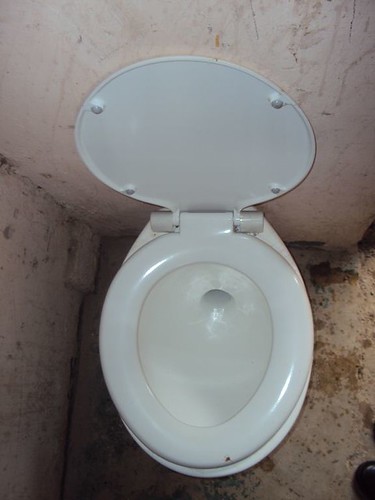
Azalea N pedestal view 1 11.9.10 by Sustainable sanitation , on Flickr
This is a photo of the first trial unit - commissioned 1 Sept 2010 and working well to this day. Due to the site layout the leach pit had to be 17 metres away, and even though the sewer grade is quite flat (1% to 2%)it still works. It seems the waste moves in stages with each flush until it reaches the pit.
I think concerns over groundwater contamination from on-site sanitation are in general overstated. As we know, the most famous example of such contamination comes from cholera in London in the 1800s when high densities of people were flushing high volumes of sewage - with cholera - into cesspits which happened to be close to their source of drinking water. Where on-site sanitation, be it pit latrines, pour flush latrines or full flush with septic tanks, serve low density communities who are not using the local groundwater for their drinking water, there really is no public health risk that I can see. It is certainly a great deal better than no sanitation and more sustainable than full waterborne sanitation.
Unless a pit latrine is sited in coarse gravel or fissured rock with a lateral groundwater flow, pathogens will not move. I have done some work on monitoring groundwater contamination from pit latrines in a sandy aquifer, and found that a) soil is a very effective filter medium which prevents movement of pathogens and b) while there is a nitrate plume from a pit, it is very localised and attenuates fast. In fact I found that the greatest risk to people was poor sanitary practices around water wells, not groundwater contamination from toilets. Prof Simon Lorentz and his masters student Bruce Wickam are now doing a very comprehensive study on pits and pour flush latrines in the Pietermaritzburg area. Their preliminary results confirm that the impact of the nitrates are mainly localised, although you will pick up preferential flow paths in the near surface flow where there are higher nitrates. Their work should be complete by the end of 2013.
I have an interest in environmental pollution and environmental health, being the Chairman of the Duzi-uMngeni Conservation Trust (www.duct.org.za) which champions the health of the two main rivers which flow through our two main urban areas in this part of South Africa. Twenty years of comprehensive monitoring of E coli in these rivers by our water authorities proves conclusively that the greatest environmental threat to these rivers is created by dysfunctional sewage systems. Our rivers are far more polluted below sewered areas than they are below unsewered areas with on-site sanitation. We are talking orders of magnitude difference here.
VIPs are robust and way better than no sanitation. However for too long we have been stuck in a binary pradigm - VIPs or full flush waterborne sanitation. There are options between, and pour flush makes an excellent step up the ladder from the VIP, combining many of the advantages of full flush (aesthetics,the water seal, odour control) with the advantages of the VIP (low cost, no moving parts, simple). The advantages over the VIP have been stated in the post. Users don't use these toilets as a convenient way of getting rid of their trash, which means pits last longer and are easier to empty. The pits are more accessible, and switching between pits is much simpler than moving a VIP structure.
My hope is that this technology will spread itself through its own logic, with affordable pour flush pedestals becoming available at local plumbing and building supply stores. If pit emptying is neither affordable, desirable or practical, VIP owners can simply close them up and retrofit pour flush with offset pits.
There is nothing to stop pour flush from being combined with EcoSan. As with all types of sanitation, many variations and options are possible.
+++++++++++++++++++
Note by moderator: Dave's introduction of himself is visible here:
www.pid.co.za/index.php/fsm2-conference/...-development-pty-ltd
Dave
Please Log in to join the conversation.
You need to login to reply
The main reasons people have pour flush into pits as opposed to VIP are
- Their first pit has filled up, either they do not have the money of knowledge for exhaustion, but do not have space to rebuild their latrine elsewhere. So they keep the current super structure, dig a pit outside of their plot lines (underground with a simple manhole cover) and convert the VIP to pour flush to wash waste into 2nd pit
- Throwing solid waste into pits is a real problem here, so landlords who want to have their pits exhausted will make their latrines pour flush so people can not throw trash in them. Also pour flush pits are much easier to exhaust because of the moisture level in the pits
- It is seen as an upgrade from VIP latrines, so if you have slightly more money, and want to charge slightly more rent from your tenants it is an easy way to look much more fancy
note* most people use lake water and/or rain water for their water source into the pour flush toilets
Sanitation Engineer working with solar FS treatment
Please Log in to join the conversation.
You need to login to reply


However, I question a bit if it is an really good idea to introduce them... it has most of the disadvantes of a regular flush toilet, and handling the potentially contaminated water (either from a bad source as people will probably not use drinkingwater, or from people previously using the toilet and washing off shit from fingers for example) is an additional risk factor.
If the toilet is connected to a biogas system it is probably a suitable solution though.
Please Log in to join the conversation.
You need to login to reply- Elisabeth
-
Topic Author
- User is blocked
- Freelance consultant since 2012
Less- Posts: 3372
- Karma: 54
- Likes received: 932
Are pour flush toilets a good idea for (South) Africa?
Have you ever wondered why pour flush toilets are not common in Sub-Saharan Africa even though they are so common in Asia? Is it mainly because water is scarcer in SSA, and if you have to carry water on your head for kilometres then you don't want to flush it down a toilet? Or could it be the case that this option is simply not well known yet?
In South Africa, some people are challenging this idea that pour flush toilets are only for Asia and not for Africa. I find that quite interesting. I learnt more about it at the recent FSM-2 conference in Durban.
First a curiosity: this is the artificial poo used for the flushing trials (it is actually soy paste (tofu) inside of a condom) (sorry, my camera didn't focus properly):
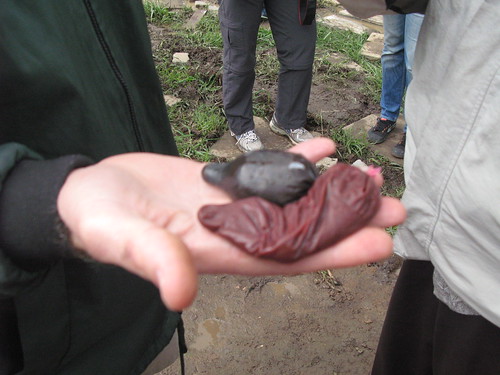
Artificial poo for testing the flushing by Sustainable sanitation , on Flickr
Secondly, the engineers wanted a sitting version of the pour flush toilet because sitting is now more common/desirable in South Africa than squatting (or maybe I need to omit the "now" in this sentence; has it always been more common to sit?).
This is what a sitting pour flush toilet looks like:
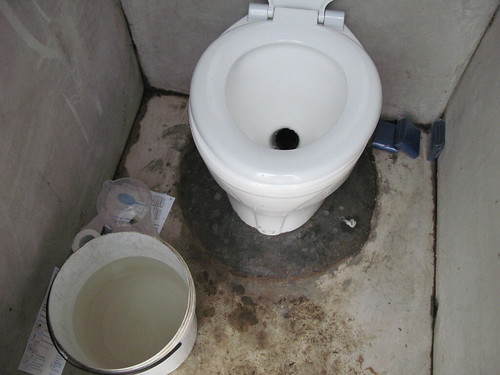
South Africa's first pour flush latrine? by Sustainable sanitation , on Flickr
The bucket on the left contains the flushing water. Only 1-2 L are needed for the flush.
The toilet has two soak pits. This is one of them:
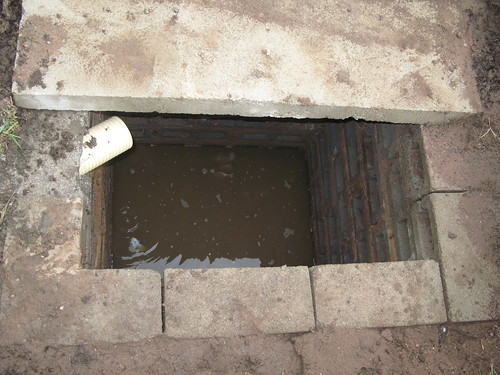
First soak pit of pour flush latrine by Sustainable sanitation , on Flickr
And this photo shows all of us marvelling at this prototype:
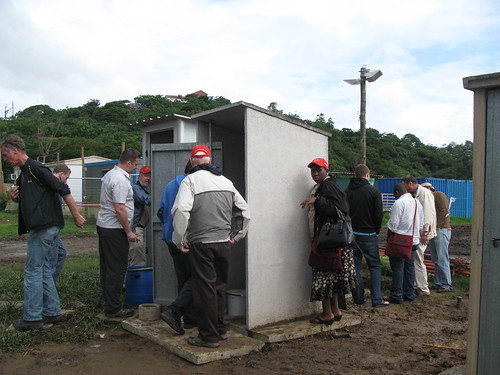
South Africa's first pour flush latrine? by Sustainable sanitation , on Flickr
Advantages of pour flush toilets:
- unlike a pit latrine it can be built onto a house
- unlike a normal toilet it uses only a litre or two for flushing
- it is cheaper to build than a full flush toilet with septic tank and soak pit
- because pour flush latrines are often flushed manually using a bucket, grey water can be used for flushing without the need to a piped recycling system
- users cannot use the pit as a receptacle for domestic waste (unless they access the pit separately)
- A pour flush pit can be emptied using a vacuum tanker, which is difficult in the case of pit latrines due to the more dense and dry nature of the sludge, and in particular due to the increased solid waste content.
- Water is required for operation (although not much is needed)
- Asian pour flush users don’t use paper. What happens when paper is added?
- The pour flush pit is not designed to dispose of general household sullage (greywater, principally wash water). If sullage is disposed of through the pour flush toilet, or by a separate pipe into the pour flush pit, then only a baffled septic tank with a separate soak pit will work properly.
- The traditional Asian pour flush latrine is designed with a squat pan. In South Africa any technology with does not incorporate a pedestal with a seat will encounter great resistance
www.susana.org/images/documents/07-cap-d...wrc-south-africa.pdf
Here is the full report which was made to WRC:
www.susana.org/lang-en/library?view=ccbktypeitem&type=2&id=1635
Summary of the report:
++++++++++++
++++++++++++++This project investigated the potential for modifying the pour flush design, which is used widely in Asia, to meet the needs of the South African context. The development and application of pour flush systems in Asia was studied. Three case studies were conducted to investigate the experience of South Africans with low flush systems in the past and related technologies were surveyed. A prototype was developed and tested after which the technology was piloted in twenty homes for usage periods of up to eighteen months. The systems were monitored over the course of the project and performance and user experience were assessed at the end of the project.
The following key findings have come out of this study (shortened from full report):
• South African experience with low flush systems. User perceptions expressed during the case studies conducted in this study with the DSA and Hungerford Schroeder low flush systems indicated that users perceived a number of problems with their systems. While some experimental aspects of the design of these systems may have led to operational problems over time, there is clearly a complex relationship between a number of factors which contribute to the success or failure of a system: system design, correct installation, availability of replacement parts, user behaviour and user attitudes – which can be influenced to a large extent by political and social dynamics.
• Design. The pour flush system developed in this study has proven successful over the first 18 months of testing. To date, only one blockage has been experienced in any of the 20 systems, and this was caused by a child flushing a plastic bag down the toilet. The one litre flush has proved adequate for typical situations, with a two litre flush sometimes used where there is a particularly long sewer leading to the soak pit.
• User satisfaction has been high and visitors to the homes where the technology was piloted expressed an interest in the pour flush model. Responses indicate that the pour flush system adequately addresses the wish of many dry sanitation users for a flush toilet, with the political, social and logistical considerations involved.
• Life span. Measurements of sludge depth were taken for seven pits. The pits were found to be filling at a rate ranging from 114 litres per year to 392 litres per year. When calculated based on the number of householders, filling rates ranged from 26 litres per person per year to 57 litres per person per year, with a median filling rate of 35 litres per person per year. Considering degradation and leaching over time, this indicates a probable life span of approximately 5 years before the pits need to be emptied. The sludge to date appears to be of a consistency which could be extracted by vacuum.
• Newspaper. The toilet proved robust enough for newspaper to be flushed without blocking the system during testing. While all households were provided with an initial pack of toilet paper and encouraged to use toilet paper if possible, it was also explained to householders how to flush with newspaper if necessary. Two households have begun to use newspaper without difficulty.
• Cost. This technology is considerably less costly than installing a full flush toilet connected to a sewer or a standard septic tank. In addition, it is not dependent on a piped water supply and can be used even if the water supply is cut off occasionally, as a small amount of water is required and greywater can be used.
• Rubbish. All respondents indicated that they do not use the toilet for disposal of any other waste. Some personal items were observed in some pits a year after construction, however, in a community that has no reliable rubbish collection. The presence of waste in the pit could present difficulties when the pit needs to be emptied.
What do you think? Does that give you food for thought? Do you think it is dangerous to go down this route because of the possibility for groundwater pollution? Would you say dry toilets are always the better option and we should not confuse people with this additional option?
Regards,
Elisabeth
Freelance consultant on environmental and climate projects
Please Log in to join the conversation.
You need to login to reply- Forum
- categories
- Sanitation systems
- Toilets without urine diversion
- Comparisons of various toilet types
- Are pour flush toilets a good idea for (South) Africa?