









- Forum
- categories
- Sanitation systems
- Toilets without urine diversion
- Innovations and research in toilet design
- Grant on Advanced Toilet with On-Site Water Recovery (Eawag and EOOS, Switzerland and Austria) – Blue diversion toilet
Grant on Advanced Toilet with On-Site Water Recovery (Eawag and EOOS, Switzerland and Austria) – Blue diversion toilet
89.7k views


Re: Diversion for Safe Sanitation - Grant on Advanced Toilet with On-Site Water Recovery (Eawag and EOOS, Switzerland and Austria)
Dear Genevieve
Thank you very much for your message and interest in the Blue Diversion Toilet. So far we have been testing our prototype in Uganda and Kenya with very promising results, however, nothing has been done in Ethiopia so far. We would of course be very interested in field testing in Ethiopia, especially regarding the business model which we couldn't apply under real conditions so far, but technically wise this won't be possible. Our prototype needs to undergo a reengineering before going into the field again, implementing our findings from Nairobi.
At the moment we are seeking for industrial partners or investors in order to do so. You are a bit too early with your request since there are no "other" prototypes available.
I hope we could help you with this answer. If there is any path change, we will definitely give you an update.
All the best,
Stefanie
Thank you very much for your message and interest in the Blue Diversion Toilet. So far we have been testing our prototype in Uganda and Kenya with very promising results, however, nothing has been done in Ethiopia so far. We would of course be very interested in field testing in Ethiopia, especially regarding the business model which we couldn't apply under real conditions so far, but technically wise this won't be possible. Our prototype needs to undergo a reengineering before going into the field again, implementing our findings from Nairobi.
At the moment we are seeking for industrial partners or investors in order to do so. You are a bit too early with your request since there are no "other" prototypes available.
I hope we could help you with this answer. If there is any path change, we will definitely give you an update.
All the best,
Stefanie
Steffi Enssle
Eawag (The Swiss Federal Institute of Aquatic Science and Technology)
Process Engineering
www.autarky.ch
www.bluediversiontoilet.com
Eawag (The Swiss Federal Institute of Aquatic Science and Technology)
Process Engineering
www.autarky.ch
www.bluediversiontoilet.com
Please Log in to join the conversation.
You need to login to reply- kengelly
-
 Less
Less- Posts: 38
- Karma: 4
- Likes received: 11
Re: Diversion for Safe Sanitation - Grant on Advanced Toilet with On-Site Water Recovery (Eawag and EOOS, Switzerland and Austria)
Hi Stefanie,
It'd be wonderful to hear how things are progressing!
Our PSI team in Ethiopia has a bit of funding and are very eager to address the issue of a water-washing culture in an urban slum environment and perhaps the blue diversion toilet is a solution worth testing there. Has any work been done in Ethiopia to date? Alternatively, do you think your team would be interested in doing some testing there? Or can we purchase any models to test ourselves? At PSI we're more focused on the business/operational model around the toilet, but this continues to be a technology challenge we have yet to see a solution for in Ethiopia.
Best,
Genevieve
It'd be wonderful to hear how things are progressing!
Our PSI team in Ethiopia has a bit of funding and are very eager to address the issue of a water-washing culture in an urban slum environment and perhaps the blue diversion toilet is a solution worth testing there. Has any work been done in Ethiopia to date? Alternatively, do you think your team would be interested in doing some testing there? Or can we purchase any models to test ourselves? At PSI we're more focused on the business/operational model around the toilet, but this continues to be a technology challenge we have yet to see a solution for in Ethiopia.
Best,
Genevieve
Genevieve Kelly
Graduate Student | MBA & MPH
Johns Hopkins University
Baltimore, MD USA | tel: 570-854-5075 skype: kengelly
This email address is being protected from spambots. You need JavaScript enabled to view it.
Graduate Student | MBA & MPH
Johns Hopkins University
Baltimore, MD USA | tel: 570-854-5075 skype: kengelly
This email address is being protected from spambots. You need JavaScript enabled to view it.
Please Log in to join the conversation.
You need to login to replyRe: Diversion for Safe Sanitation - Grant on Advanced Toilet with On-Site Water Recovery (Eawag and EOOS, Switzerland and Austria)
Dear Forum-Users
I just wanted to give you a little update on this project in case you are wondering about its progress: The Gates Foundation has unfortunately decided against giving further funding for this research for now. Reason: they want to focus on “reinvented toilets” that treat all the excreta at the household level, which is something that this toilet cannot do (it is only treating the flush and washwater at the household level).
Nevertheless, things might still be progressing. Eawag is currently talking to a toilet manufacturer who is interested in the filtering mechanism that is installed in the vertical back part of the toilet.
You should also know, that Eawag recently received BMGF-funding for a new project called AUTARKY, to develop a complete on-site treatment toilet. Similar to Blue Diversion, water, urine and feces are being separated and hopefully - by the end of 2016 - treated directly in the toilet. The final products will be water and precipitated solids. However, I don't want to confuse you for which reason we will present AUTARKY in detail in a new thread.
Best regards,
Stefanie
I just wanted to give you a little update on this project in case you are wondering about its progress: The Gates Foundation has unfortunately decided against giving further funding for this research for now. Reason: they want to focus on “reinvented toilets” that treat all the excreta at the household level, which is something that this toilet cannot do (it is only treating the flush and washwater at the household level).
Nevertheless, things might still be progressing. Eawag is currently talking to a toilet manufacturer who is interested in the filtering mechanism that is installed in the vertical back part of the toilet.
You should also know, that Eawag recently received BMGF-funding for a new project called AUTARKY, to develop a complete on-site treatment toilet. Similar to Blue Diversion, water, urine and feces are being separated and hopefully - by the end of 2016 - treated directly in the toilet. The final products will be water and precipitated solids. However, I don't want to confuse you for which reason we will present AUTARKY in detail in a new thread.
Best regards,
Stefanie
Steffi Enssle
Eawag (The Swiss Federal Institute of Aquatic Science and Technology)
Process Engineering
www.autarky.ch
www.bluediversiontoilet.com
Eawag (The Swiss Federal Institute of Aquatic Science and Technology)
Process Engineering
www.autarky.ch
www.bluediversiontoilet.com
The following user(s) like this post: Elisabeth, canaday, dorothee.spuhler
Please Log in to join the conversation.
You need to login to reply
Re: Grant on Advanced Toilet with On-Site Water Recovery (Eawag and EOOS, Switzerland and Austria) – currently testing the blue diversion toilet in urban slums

Dear Forum Users,
This is to announce that the Blue Diversion Toilet has won the Project Innovation Awards 2014 assigned by the International Water Association (IWA).
Please find more information about the award on the website: www.iwa-pia.org/pia_award_eu.html
and about other categories' Prize Winners in the .pdf attached.
All about the Blue Diversion Toilet can be found on:
www.bluediversiontoilet.com
We would also like to remind you that the award will be presented soon, on 25th June 2014.
[posted by Sebastian Klos]
This is to announce that the Blue Diversion Toilet has won the Project Innovation Awards 2014 assigned by the International Water Association (IWA).
Please find more information about the award on the website: www.iwa-pia.org/pia_award_eu.html
and about other categories' Prize Winners in the .pdf attached.
All about the Blue Diversion Toilet can be found on:
www.bluediversiontoilet.com
We would also like to remind you that the award will be presented soon, on 25th June 2014.
[posted by Sebastian Klos]
This attachment is hidden for guests.
Please log in or register to see it.
Please log in or register to see it.
Posted by a member of the SuSanA secretariat held by the GIZ Sector Program Water Policy – Innovations for Resilience
Located at Deutsche Gesellschaft für Internationale Zusammenarbeit (GIZ) GmbH, Bonn, Germany
Follow us on facebook: www.facebook.com/susana.org, linkedin: www.linkedin.com/company/sustainable-sanitation-alliance-susana and twitter: twitter.com/susana_org
Located at Deutsche Gesellschaft für Internationale Zusammenarbeit (GIZ) GmbH, Bonn, Germany
Follow us on facebook: www.facebook.com/susana.org, linkedin: www.linkedin.com/company/sustainable-sanitation-alliance-susana and twitter: twitter.com/susana_org
This message has an attachment file.
Please log in or register to see it.
The following user(s) like this post: bernhard
Please Log in to join the conversation.
You need to login to reply- emorgenr
-
 Less
Less- Posts: 1
- Karma: 1
- Likes received: 2
Re: Grant on Advanced Toilet with On-Site Water Recovery (Eawag and EOOS, Switzerland and Austria) – currently testing the blue diversion toilet in urban slums
There was significant interest in the Blue Diversion toilet at the Reinvent the Toilet Fair in Delhi last week. See a video here:
and go to www.bluediversiontoilet.com/safe.html for further technical information.
Best regards,
Eberhard
++++++++++
Prof. Dr. Eberhard Morgenroth
ETH Zurich
Chair of Process Engineering in Urban Water Management
Institute of Environmental Engineering (IfU)
www.ifu.ethz.ch/SWW
and
Eawag
Process Engineering (Room BU-B13)
CH-8600 Duebendorf, Switzerland
www.eawag.ch
www.eawag.ch/about/personen/homepages/morgeneb
+++++++++++++
Some photos from the exhibit (added by EvM):
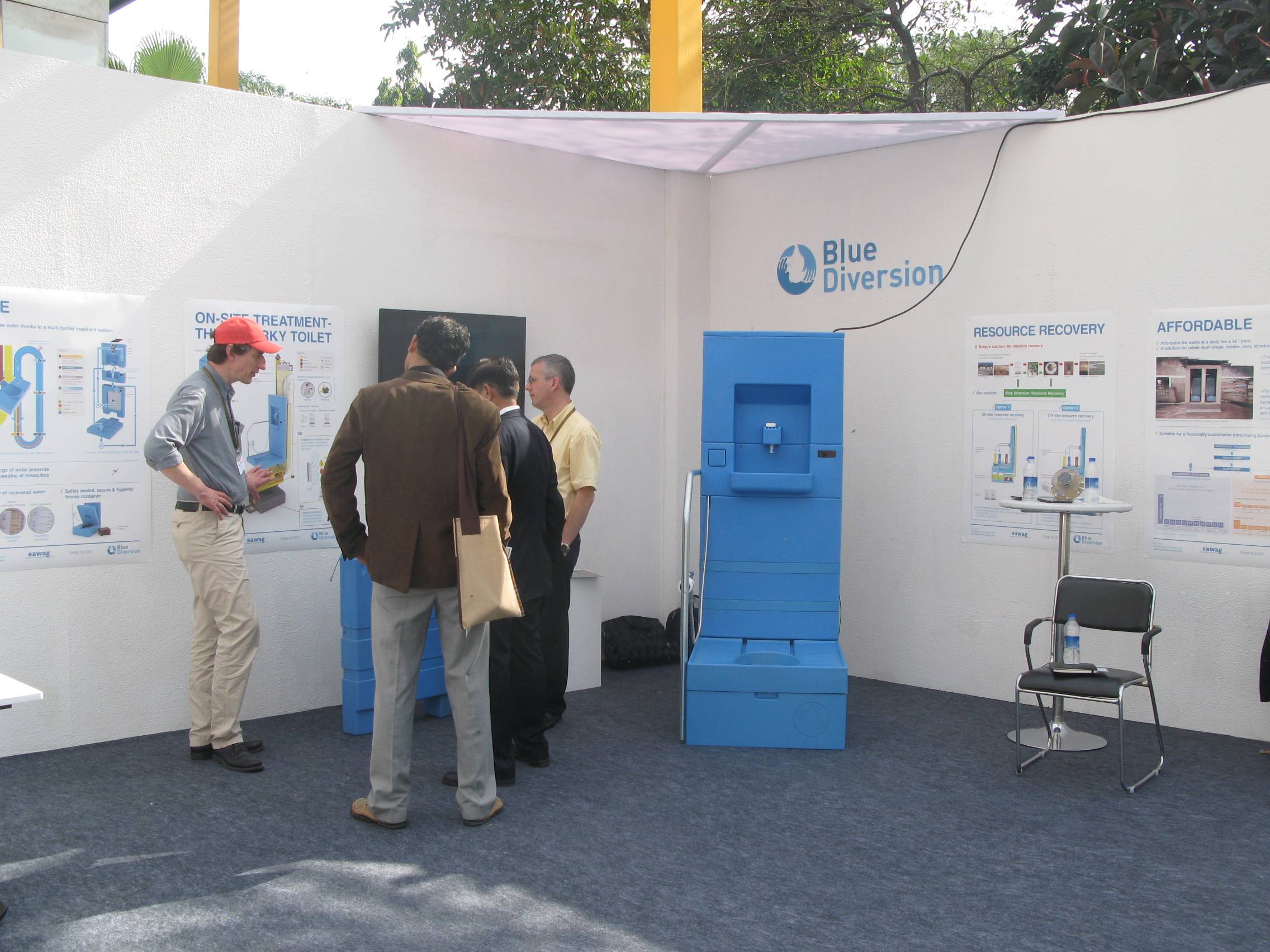 The Blue Diversion exhibit at the Toilet Fair
by
Sustainable sanitation
, on Flickr
The Blue Diversion exhibit at the Toilet Fair
by
Sustainable sanitation
, on Flickr
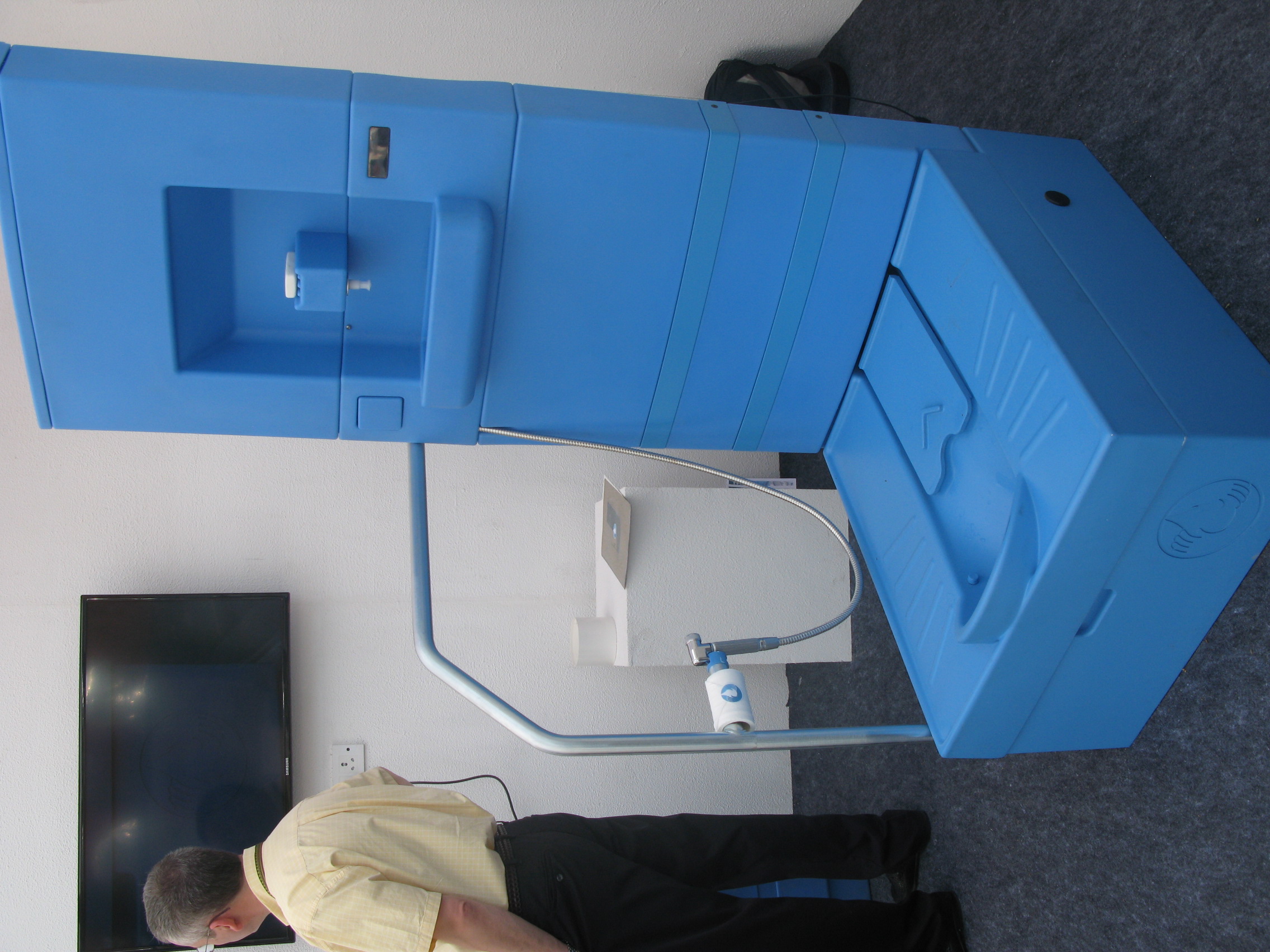 Blue Diversion Toilet Prototype
by
Sustainable sanitation
, on Flickr
Blue Diversion Toilet Prototype
by
Sustainable sanitation
, on Flickr
and go to www.bluediversiontoilet.com/safe.html for further technical information.
Best regards,
Eberhard
++++++++++
Prof. Dr. Eberhard Morgenroth
ETH Zurich
Chair of Process Engineering in Urban Water Management
Institute of Environmental Engineering (IfU)
www.ifu.ethz.ch/SWW
and
Eawag
Process Engineering (Room BU-B13)
CH-8600 Duebendorf, Switzerland
www.eawag.ch
www.eawag.ch/about/personen/homepages/morgeneb
+++++++++++++
Some photos from the exhibit (added by EvM):
The following user(s) like this post: Elisabeth, bernhard
Please Log in to join the conversation.
You need to login to reply- markokeefe
-
 Less
Less- Posts: 1
- Likes received: 1
Re: Grant on Advanced Toilet with On-Site Water Recovery (Eawag and EOOS, Switzerland and Austria) – currently testing the blue diversion toilet in urban slums
Hello,
this is the first in a series of blog posts about testing the blue diversion toilet with Sanergy in Mukuru, Nairobi. Thoughts, comments and questions are welcomed.
Cheers,
Mark
www.bluediversiontoilet.com/blog.html
this is the first in a series of blog posts about testing the blue diversion toilet with Sanergy in Mukuru, Nairobi. Thoughts, comments and questions are welcomed.
Cheers,
Mark
www.bluediversiontoilet.com/blog.html
The following user(s) like this post: Elisabeth
Please Log in to join the conversation.
You need to login to reply

Re: Grant on Advanced Toilet with On-Site Water Recovery (Eawag and EOOS, Switzerland and Austria) – currently testing the blue diversion toilet in urban slums

Dear Tove,
I am glad to hear of the macroorganisms. I think the Oligochaetes may be easier to manage and more acceptable to users and maintenance staff.
I may have jumped to the conclusion of nitrates, but nitrogen in general needs to be removed from the water ... and the Oligochaetes should help with this to some extent.
I do not remember activated carbon being mentioned before, but this is a good option. Is there a reason to not also have a sand filter?
I consider the Blue Diversion Toilet to have enormous application in many situations, including up-scale, urban homes in developed countries. In addition, not all developing countries are stressed for water. For this reason, it would be good to have a couple of different models. A non-fully recycling model could still use filtered hand and anal washwater to flush the system, thus demanding and emitting only tiny amounts of water.
I wish you great success.
Best wishes,
Chris
I am glad to hear of the macroorganisms. I think the Oligochaetes may be easier to manage and more acceptable to users and maintenance staff.
I may have jumped to the conclusion of nitrates, but nitrogen in general needs to be removed from the water ... and the Oligochaetes should help with this to some extent.
I do not remember activated carbon being mentioned before, but this is a good option. Is there a reason to not also have a sand filter?
I consider the Blue Diversion Toilet to have enormous application in many situations, including up-scale, urban homes in developed countries. In addition, not all developing countries are stressed for water. For this reason, it would be good to have a couple of different models. A non-fully recycling model could still use filtered hand and anal washwater to flush the system, thus demanding and emitting only tiny amounts of water.
I wish you great success.
Best wishes,
Chris
Conservation Biologist and EcoSan Promoter
Omaere Ethnobotanical Park
Puyo, Pastaza, Ecuador, South America
inodoroseco.blogspot.com
Omaere Ethnobotanical Park
Puyo, Pastaza, Ecuador, South America
inodoroseco.blogspot.com
Please Log in to join the conversation.
You need to login to reply
Re: Grant on Advanced Toilet with On-Site Water Recovery (Eawag and EOOS, Switzerland and Austria) – currently testing the blue diversion toilet in urban slums
Dear Chris
Just a short reply to some of your main points.
We will be testing whether the chlororganic compounds are accumulating or not.
As to the macroorganics: In similar systems, we find that nematodes and oligochaetes play a large role.
As I wrote, we are testing large surfaces for promoting biological growth after the filter. We will not use sand, but activated carbon. There is not enough degradable organic matter to eliminate nitrate at this step, and the water is oxygenated so it would not happen anyway. Nitrate is not really a problem and it does not accumulate.
The Blue Diversion toilet is intended for densely populated urban slums where there is no space for vegetated sand beds and where water will often not be able to infiltrate.
Kind regards
Tove
Just a short reply to some of your main points.
We will be testing whether the chlororganic compounds are accumulating or not.
As to the macroorganics: In similar systems, we find that nematodes and oligochaetes play a large role.
As I wrote, we are testing large surfaces for promoting biological growth after the filter. We will not use sand, but activated carbon. There is not enough degradable organic matter to eliminate nitrate at this step, and the water is oxygenated so it would not happen anyway. Nitrate is not really a problem and it does not accumulate.
The Blue Diversion toilet is intended for densely populated urban slums where there is no space for vegetated sand beds and where water will often not be able to infiltrate.
Kind regards
Tove
Swiss Federal Institute of Aquatic Science and Technology (Eawag)
Urban Water Management
Dübendorf, Switzerland
www.diversionsanitation.com
Fresh from the Press: Source Separation and Decentralization for Wastewater Management
(www.iwapublishing.com/template.cfm?name=isbn9781843393481)
Urban Water Management
Dübendorf, Switzerland
www.diversionsanitation.com
Fresh from the Press: Source Separation and Decentralization for Wastewater Management
(www.iwapublishing.com/template.cfm?name=isbn9781843393481)
The following user(s) like this post: canaday
Please Log in to join the conversation.
You need to login to replyRe: Grant on Advanced Toilet with On-Site Water Recovery (Eawag and EOOS, Switzerland and Austria) – currently testing the blue diversion toilet in urban slums
Dear Tove,
Thank you for getting back to me, although our perspectives are widely divergent.
What macro organisms will be inside the membrane?
The link you gave does not explain the process of this type of electrolysis. It does however state "Through electrolysis, chlorine is produced and immediately injected into the pool circulation system. These units are messy and produce by-products that are not simple to dispose of."
I think I may have found an explanation of your style of electrolysis, if this is the Cloralcali Process:
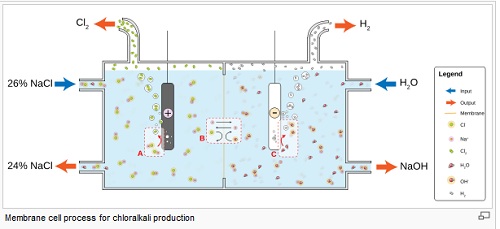
en.wikipedia.org/wiki/Chlorine
You have given no explanation why chlorinated hydrocarbons should not accumulate in the water, growing constantly in concentration in the water the users occupy to wash their hands and genitals. This is the same family of chemicals as DDT and Dioxin, which includes some of the most toxic chemicals known, and they do not biodegrade easily.
The same Wikipedia page states:
"Organochlorine compounds as pollutants
Some organochlorine compounds are serious pollutants. These are produced either as by-products or end products of industrial processes which are persistent in the environment, such as certain chlorinated pesticides and chlorofluorocarbons. Chlorine is added both to pesticides and pharmaceuticals to make the molecules more resistant to enzymatic degradation by bacteria, insects, and mammals, but this property also has the effect of prolonging the residence time of these compounds when they enter the environment." (Or in this case, the recycling aquatic ecosystem of the Blue Diversion.)
I see no response to my suggestion of adding a sand filter (with its helpful biofilm). I think that this would contribute considerably to the visual clarity of the water and the elimination of substances that pass through the membrane (e.g., nitrates), which I think are the most important two factors between the membrane and the user, more than the risk of pathogens swimming upstream (against which a one-way valve could be added).
I suggest you consider making the water recycling optional, with a switch to turn it on. For example, in times and places where there is abundant water, the Blue Diversion could be piped in and the small amount of effluent could go a Vegetated Sand Bed. The same unit, in times of water shortage, could be switched to recycling. One problem would be the stable growth of the beneficial microbes. So it may be simpler to produce 2 models.
I also suggest you consult with several good microbiologists about the chlorine-resistant strains of microbes that may develop.
Good luck. I will stop interrupting you. I think all my points are still valid and they can be reviewed whenever one likes, here on the Forum.
Best wishes,
Chris
Thank you for getting back to me, although our perspectives are widely divergent.
What macro organisms will be inside the membrane?
The link you gave does not explain the process of this type of electrolysis. It does however state "Through electrolysis, chlorine is produced and immediately injected into the pool circulation system. These units are messy and produce by-products that are not simple to dispose of."
I think I may have found an explanation of your style of electrolysis, if this is the Cloralcali Process:
en.wikipedia.org/wiki/Chlorine
You have given no explanation why chlorinated hydrocarbons should not accumulate in the water, growing constantly in concentration in the water the users occupy to wash their hands and genitals. This is the same family of chemicals as DDT and Dioxin, which includes some of the most toxic chemicals known, and they do not biodegrade easily.
The same Wikipedia page states:
"Organochlorine compounds as pollutants
Some organochlorine compounds are serious pollutants. These are produced either as by-products or end products of industrial processes which are persistent in the environment, such as certain chlorinated pesticides and chlorofluorocarbons. Chlorine is added both to pesticides and pharmaceuticals to make the molecules more resistant to enzymatic degradation by bacteria, insects, and mammals, but this property also has the effect of prolonging the residence time of these compounds when they enter the environment." (Or in this case, the recycling aquatic ecosystem of the Blue Diversion.)
I see no response to my suggestion of adding a sand filter (with its helpful biofilm). I think that this would contribute considerably to the visual clarity of the water and the elimination of substances that pass through the membrane (e.g., nitrates), which I think are the most important two factors between the membrane and the user, more than the risk of pathogens swimming upstream (against which a one-way valve could be added).
I suggest you consider making the water recycling optional, with a switch to turn it on. For example, in times and places where there is abundant water, the Blue Diversion could be piped in and the small amount of effluent could go a Vegetated Sand Bed. The same unit, in times of water shortage, could be switched to recycling. One problem would be the stable growth of the beneficial microbes. So it may be simpler to produce 2 models.
I also suggest you consult with several good microbiologists about the chlorine-resistant strains of microbes that may develop.
Good luck. I will stop interrupting you. I think all my points are still valid and they can be reviewed whenever one likes, here on the Forum.
Best wishes,
Chris
Conservation Biologist and EcoSan Promoter
Omaere Ethnobotanical Park
Puyo, Pastaza, Ecuador, South America
inodoroseco.blogspot.com
Omaere Ethnobotanical Park
Puyo, Pastaza, Ecuador, South America
inodoroseco.blogspot.com
Attachments:
-
Cloralcali...rine.jpg
(Filesize: 31KB)
Please Log in to join the conversation.
You need to login to replyRe: Grant on Advanced Toilet with On-Site Water Recovery (Eawag and EOOS, Switzerland and Austria) – currently testing the blue diversion toilet in urban slums
Dear Chris
Sorry for the late answer, but as I wrote to you personally, I wanted to check a few things before I answered publically. You are raising some very interesting questions with respect to the possible accumulation of chlorinated organic compounds, which I wanted first to discuss with my colleagues.
First of all, however, I would like to emphasize that the water recovery system in Blue Diversion works exactly as you suggest it should: it is a microcosmos of micro and macro organisms, where more than 95 % of the organic material is degraded. The macro organisms keep the filter open and the system is totally self-organizing; all it takes is air for keeping the filter aerobic. Also for this purpose we need electricity; not only for electrolysis. The biofilm on the filter does take part in the degradation and we are not fighting it.
You have some questions with respect to the different types of organic matter in the wastewater. In the water recovery unit of Blue Diversion, these different types are all degraded, exept for the very resistent molecules.
The water filtered in the system is safe, but it may not stay so. Pathogens can enter the system from the tap and the shower head and live on the rest of the organic matter. The water is also not too appeling as it is slightly colored. In order to protect the users against the regrowth of pathogens, we apply electrolysis for the production of chlorine. Chlorine is the gold standard for obtaining hygienic water and it also has the pleasant side effect of removing color from the treated water. This makes it much more appealing to wash your hands with the water.
In principle, we do not see any difference to normal chlorination of drinking water. We do not expect any accumulation of chlorinated compounds, but expect those to be degraded in the biological treatment. This, of course, we will have to prove - thank you for rising the question. With respect to chlorine resistance, the problem in water pipes is the biofilms and there the risk of resistance would be equally high.
In your questions, you indicated that biofilms could be a problem for clogging of the pipes. This is certainly not a problem here. The water is treated to a high degree, but in order to prevent microbial growth, we need to get lower than 10 ng of COD. This is not possible in the type of systems we are discussing here.
I am rather doubtful about the aquarium idea and I do not think it would solve the problem of pathogen regrowth. Reintroducing organic matter does not seem such a good idea, apart from all the practical problems, which you mention yourself.
We are not using a food pump for opening the water tap and have also removed the ones originally in the toilet. Our first field test revealed that small children had problems using the pump. This is also a practical problem of getting the price and the size of the toilet down. In a few weeks, the pictures of the new toilet will go online on www.bluediversiontoilet.com and you will see that the touching point is very small. Combined with hand washing with soap, we hope that this will minimize cross contamination between users (please remember: this is not a public toilet, but a toilet shared by up to 10-12 people, ideally 1-2 families).
Another comment on the foot pump: The ultrafiltration membrane works with gravity and the water has to be pumped up. For the reasons mentioned above, this is now done by an electrical pump and not by a foot pump. Still, however, energy consumption is very low.
You suggest to introduce the mycofilter, which can not survive submerged. We tried out a trickling filter in the beginning of the project, despite the advice from a number of experienced engineers that it would be eaten by flies. They were right, so we are reluctant to try yet another trickling filter.
For the practical information on electrolysis for chlorine formation: This is an old technology used in the chlor-alkali industry for producing chlorine from chloride (see, e.g. wikipedia for an overview). I am surprised that you do not find this technology on the internet; there are so many sites that I hesitate to choose one, but see e.g.
phoenix.about.com/cs/wet/a/saltpool01_2.htm for a common application (producing chlorine from kitchen salt for residential swimming pools). The chemistry of electrolysis is of course complex and the choice e.g. of electrodes, potential applied and distance between the electrodes all influence the result. We have optimized a commercial system for very low energy consumption, but there is still work to do to lower the costs of the system.
In order to get the toilet out as soon as possible, we have already industrialized the water wall. This means that there is little room for changes, although we are experimenting with some additional surfaces for decreasing the organic matter in the effluent even more. However, we are operating the water recovery system without any sludge removal (another advantage of the system from the point of view of maintenance), which leaves relatively little scope for further biological degradation.
We do of course hope that other people will help further develop the system, but at the moment we concentrate on understanding the user experience and we look very much forward to the coming field tests in Nairobi, which will be conducted in cooperation with Sanergy.
I hope I succeeded in answering your questions. Thank you for your interest
Kind regards
Tove
Sorry for the late answer, but as I wrote to you personally, I wanted to check a few things before I answered publically. You are raising some very interesting questions with respect to the possible accumulation of chlorinated organic compounds, which I wanted first to discuss with my colleagues.
First of all, however, I would like to emphasize that the water recovery system in Blue Diversion works exactly as you suggest it should: it is a microcosmos of micro and macro organisms, where more than 95 % of the organic material is degraded. The macro organisms keep the filter open and the system is totally self-organizing; all it takes is air for keeping the filter aerobic. Also for this purpose we need electricity; not only for electrolysis. The biofilm on the filter does take part in the degradation and we are not fighting it.
You have some questions with respect to the different types of organic matter in the wastewater. In the water recovery unit of Blue Diversion, these different types are all degraded, exept for the very resistent molecules.
The water filtered in the system is safe, but it may not stay so. Pathogens can enter the system from the tap and the shower head and live on the rest of the organic matter. The water is also not too appeling as it is slightly colored. In order to protect the users against the regrowth of pathogens, we apply electrolysis for the production of chlorine. Chlorine is the gold standard for obtaining hygienic water and it also has the pleasant side effect of removing color from the treated water. This makes it much more appealing to wash your hands with the water.
In principle, we do not see any difference to normal chlorination of drinking water. We do not expect any accumulation of chlorinated compounds, but expect those to be degraded in the biological treatment. This, of course, we will have to prove - thank you for rising the question. With respect to chlorine resistance, the problem in water pipes is the biofilms and there the risk of resistance would be equally high.
In your questions, you indicated that biofilms could be a problem for clogging of the pipes. This is certainly not a problem here. The water is treated to a high degree, but in order to prevent microbial growth, we need to get lower than 10 ng of COD. This is not possible in the type of systems we are discussing here.
I am rather doubtful about the aquarium idea and I do not think it would solve the problem of pathogen regrowth. Reintroducing organic matter does not seem such a good idea, apart from all the practical problems, which you mention yourself.
We are not using a food pump for opening the water tap and have also removed the ones originally in the toilet. Our first field test revealed that small children had problems using the pump. This is also a practical problem of getting the price and the size of the toilet down. In a few weeks, the pictures of the new toilet will go online on www.bluediversiontoilet.com and you will see that the touching point is very small. Combined with hand washing with soap, we hope that this will minimize cross contamination between users (please remember: this is not a public toilet, but a toilet shared by up to 10-12 people, ideally 1-2 families).
Another comment on the foot pump: The ultrafiltration membrane works with gravity and the water has to be pumped up. For the reasons mentioned above, this is now done by an electrical pump and not by a foot pump. Still, however, energy consumption is very low.
You suggest to introduce the mycofilter, which can not survive submerged. We tried out a trickling filter in the beginning of the project, despite the advice from a number of experienced engineers that it would be eaten by flies. They were right, so we are reluctant to try yet another trickling filter.
For the practical information on electrolysis for chlorine formation: This is an old technology used in the chlor-alkali industry for producing chlorine from chloride (see, e.g. wikipedia for an overview). I am surprised that you do not find this technology on the internet; there are so many sites that I hesitate to choose one, but see e.g.
phoenix.about.com/cs/wet/a/saltpool01_2.htm for a common application (producing chlorine from kitchen salt for residential swimming pools). The chemistry of electrolysis is of course complex and the choice e.g. of electrodes, potential applied and distance between the electrodes all influence the result. We have optimized a commercial system for very low energy consumption, but there is still work to do to lower the costs of the system.
In order to get the toilet out as soon as possible, we have already industrialized the water wall. This means that there is little room for changes, although we are experimenting with some additional surfaces for decreasing the organic matter in the effluent even more. However, we are operating the water recovery system without any sludge removal (another advantage of the system from the point of view of maintenance), which leaves relatively little scope for further biological degradation.
We do of course hope that other people will help further develop the system, but at the moment we concentrate on understanding the user experience and we look very much forward to the coming field tests in Nairobi, which will be conducted in cooperation with Sanergy.
I hope I succeeded in answering your questions. Thank you for your interest
Kind regards
Tove
Swiss Federal Institute of Aquatic Science and Technology (Eawag)
Urban Water Management
Dübendorf, Switzerland
www.diversionsanitation.com
Fresh from the Press: Source Separation and Decentralization for Wastewater Management
(www.iwapublishing.com/template.cfm?name=isbn9781843393481)
Urban Water Management
Dübendorf, Switzerland
www.diversionsanitation.com
Fresh from the Press: Source Separation and Decentralization for Wastewater Management
(www.iwapublishing.com/template.cfm?name=isbn9781843393481)
Please Log in to join the conversation.
You need to login to replyRe: Grant on Advanced Toilet with On-Site Water Recovery (Eawag and EOOS, Switzerland and Austria) – currently testing the blue diversion toilet in urban slums
Dear Tove,
Thanks for your kind response in November, which, for some reason, I have only recently seen.
Tribecraft seems to have much to offer to the process, according to their following brochure:
www.tribecraft.ch/german/download/brochu...ibecraft_english.pdf
I continue to think that, aside from the high-tech micropore membrane, the treatment of water from hand and anus washing in the BlueDiversion UDDT could be done via natural processes and in this way be safer, more reliable (no problems of chlorine not being replenished or electric generators malfunctioning), more sustainable, and better for the environment. Natural ecosystems decontaminate wastewater, so I am trying to figure out how put an entire tiny ecosystem into the wall of the BlueDiversion.
I still would argue against the use of chlorine. Among other things, with the constant recycling, this could create the conditions to promote the evolution of strains of microbes that are resistant to chlorine, inside and outside of the membrane … and those inside could get into the general environment via membrane failure or decommissioning of old membranes. Living biological filters, in contrast, include microbes that should evolve to be more and more effective at cleaning the water over time.
Yes, the organic matter can eat up the chlorine … and make chemicals that are even more toxic. It could combine with urine to form trichloramine, which can cause asthma and other respiratory and eye problems.
erj.ersjournals.com/content/29/4/690.full
Carcinogenic chlorinated hydrocarbons (e.g., link.springer.com/article/10.1007/BF00051702#page-1, bladder cancer from chlorinated drinking water
www.ncbi.nlm.nih.gov/pubmed/7977393, brain cancer from occupational exposure)
can also be formed during this process, especially since the water being treated in the BlueDiversion would contain many more organic compounds, as compared to relatively clean drinking water sources. The danger here would be the washing of hands, anuses and genitals.
You say that the chlorine is to fight the formation of biofilms. I would suggest that biofilms should not be fought, but instead valued for their contribution to cleansing the water. The trick, of course, is to design the system such that biofilms do not block the flow of water and, if they start to do so, they can be easily cleared mechanically.
My aquarium suggestion comes from trying to think of a biological treatment of the water that would otherwise be sitting idly in the clean water tank toward the bottom of the wall. I cannot think of any type of organism that would more efficiently clean the water than a plant, especially since the nitrogen and other elements that would build up in the water are exactly what plants selectively absorb and the organism would need to be submerged in the water. Photosynthetic plants, of course, require light, so I suggest adding the transparent panel, and this would also encourage the users to keep the restrooms well lit, via windows, translucent roofs and electric lights. This would be of great benefit, given the overabundance of dark, dingy restrooms.
The small fishes (in addition to their function as fun ”canaries in the goldmine”) would eat the algae that would form on the inside of the window (to keep it transparent for light to get in and for people to see in) and nibble on the plants to harvest their excess growth and stimulate continued activity. Also, since many contaminants accumulate in the fat of animals, the fish would help to remove these (and I would not recommend ever eating these fish).
What other useful organism could you put in the clean water tank, with no light, low oxygen, and (your) chlorine? Could something like the SCOBY (Symbiotic Colony Of Bacteria and Yeast, en.wikipedia.org/wiki/SCOBY) of Kombucha live there? I have not been able to find any non-photosynthetic aquatic plant or alga. It seems you may need a lithotrophic organism, which means that it lives based on chemicals in the water. These are all microbes so they would have to be strained out of the water … but there is the Giant Tube Worm (Riftia pachyptila), from the bottom of the Pacific Ocean, which has lithotrophic symbionts that live inside it, only it grows over 2 meters long and probably requires saltwater, so not very practical for the BlueDiversion … so plants look better and better.
en.wikipedia.org/wiki/Giant_tube_worm
en.wikipedia.org/wiki/Lithotroph
I still do not understand this variety of electrolysis and it does not seem to be covered in Wikipedia
en.wikipedia.org/wiki/Electrolysis
Could you please provide a link for a similar electrolysis application? Where does the electricity come from? Is it produced via the foot pump? If it comes from a solar panel, what happens with shade from neighboring trees and buildings or when it is especially cloudy?
Does the Ultrafiltration work by gravity or does it require pressure that comes from the foot pump?
What happens to the lipids present in feces inside the BlueDiversion? Would a grease trap be called for upstream of the membrane?
The water faucet and the flush button could transmit pathogens from one user to another, so I recommend using foot pedals instead. Could the foot pump and the flush pedal be combined into one?
I would also like to suggest adding 2 sand filters to help cleanse the water: one with finer sand just after the membrane (that would flow at about the same rate), another in the bottom of the aquarium with coarser sand or fine gravel (that would not impede the pumping of the water). A biofilm would develop around each grain of sand that would remove and digest contaminants from the water.
In the interest of brainstorming to get more life and sustainability into the system, a Mycofilter (cellulose-rich material, like wood chips, corn cobs or straw, inoculated with selected fungus) could be added upstream, downstream or instead of the first sand filter that I just suggested. Paul Stamets has had great success with this in the decontamination of organic, chemical and pathogenic wastewater. Most macroscopic fungi could not live submerged into the clean water tank, but would do well in such a trickling filter. Maintenance could involve a neatly packed and sterilized burlap package of cellulose-rich material being placed periodically under the previous similar ones that would inoculate them with the right fungus.
fungi.com/pdf/articles/Fungi_Perfecti_Phase_I_Report.pdf
es.scribd.com/doc/50296487/Mycelium-Running-by-Paul-Stamets
www.wired.co.uk/news/archive/2012-06/25/...gus-oestrogen-filter (A pharmaceutical company is involved in this genetic engineering project to get pharmaceuticals out of water, but one could make a Mycofilter with the actual fungus, instead of putting the gene into E. coli.)
helda.helsinki.fi/bitstream/handle/10138...ation.pdf?sequence=1 (An interesting related dissertation.)
Please allow me to quote
(info.biotech-calendar.com/bid/97482/WSU-...-Purify-Water-Supply):
“Water purification is a serious problem worldwide. While good filtration systems exist, they can be expensive to implement and maintain (...) Chemicals such as chlorine are regularly utilized to kill off pathogens, but then the chemicals typically need to be removed or neutralized. The elegance of mycofiltration is that it performs its task naturally and adds no further contaminants to the water. In fact, the fungi actually neutralize the bacteria in the process of consuming it as food, so that the used mycofilters can be composted later without toxifying the soil. Finally, mycofiltration is inexpensive. Win-win.”
I would be glad to do trials of an “Aquarium Filter with Plants and Fish”, a Mycofilter, and these sand filters here in Ecuador, if you like (and especially if you can cover the costs). I could set this up for testing without the rest of the BlueDiversion, although optimally I should have the membrane filter unit.
Thank you for this continued conversation and please let me know if I can be of any help. This is a great concept and it would be an honor to contribute to its success.
Best wishes,
Chris Canaday
Thanks for your kind response in November, which, for some reason, I have only recently seen.
Tribecraft seems to have much to offer to the process, according to their following brochure:
www.tribecraft.ch/german/download/brochu...ibecraft_english.pdf
I continue to think that, aside from the high-tech micropore membrane, the treatment of water from hand and anus washing in the BlueDiversion UDDT could be done via natural processes and in this way be safer, more reliable (no problems of chlorine not being replenished or electric generators malfunctioning), more sustainable, and better for the environment. Natural ecosystems decontaminate wastewater, so I am trying to figure out how put an entire tiny ecosystem into the wall of the BlueDiversion.
I still would argue against the use of chlorine. Among other things, with the constant recycling, this could create the conditions to promote the evolution of strains of microbes that are resistant to chlorine, inside and outside of the membrane … and those inside could get into the general environment via membrane failure or decommissioning of old membranes. Living biological filters, in contrast, include microbes that should evolve to be more and more effective at cleaning the water over time.
Yes, the organic matter can eat up the chlorine … and make chemicals that are even more toxic. It could combine with urine to form trichloramine, which can cause asthma and other respiratory and eye problems.
erj.ersjournals.com/content/29/4/690.full
Carcinogenic chlorinated hydrocarbons (e.g., link.springer.com/article/10.1007/BF00051702#page-1, bladder cancer from chlorinated drinking water
www.ncbi.nlm.nih.gov/pubmed/7977393, brain cancer from occupational exposure)
can also be formed during this process, especially since the water being treated in the BlueDiversion would contain many more organic compounds, as compared to relatively clean drinking water sources. The danger here would be the washing of hands, anuses and genitals.
You say that the chlorine is to fight the formation of biofilms. I would suggest that biofilms should not be fought, but instead valued for their contribution to cleansing the water. The trick, of course, is to design the system such that biofilms do not block the flow of water and, if they start to do so, they can be easily cleared mechanically.
My aquarium suggestion comes from trying to think of a biological treatment of the water that would otherwise be sitting idly in the clean water tank toward the bottom of the wall. I cannot think of any type of organism that would more efficiently clean the water than a plant, especially since the nitrogen and other elements that would build up in the water are exactly what plants selectively absorb and the organism would need to be submerged in the water. Photosynthetic plants, of course, require light, so I suggest adding the transparent panel, and this would also encourage the users to keep the restrooms well lit, via windows, translucent roofs and electric lights. This would be of great benefit, given the overabundance of dark, dingy restrooms.
The small fishes (in addition to their function as fun ”canaries in the goldmine”) would eat the algae that would form on the inside of the window (to keep it transparent for light to get in and for people to see in) and nibble on the plants to harvest their excess growth and stimulate continued activity. Also, since many contaminants accumulate in the fat of animals, the fish would help to remove these (and I would not recommend ever eating these fish).
What other useful organism could you put in the clean water tank, with no light, low oxygen, and (your) chlorine? Could something like the SCOBY (Symbiotic Colony Of Bacteria and Yeast, en.wikipedia.org/wiki/SCOBY) of Kombucha live there? I have not been able to find any non-photosynthetic aquatic plant or alga. It seems you may need a lithotrophic organism, which means that it lives based on chemicals in the water. These are all microbes so they would have to be strained out of the water … but there is the Giant Tube Worm (Riftia pachyptila), from the bottom of the Pacific Ocean, which has lithotrophic symbionts that live inside it, only it grows over 2 meters long and probably requires saltwater, so not very practical for the BlueDiversion … so plants look better and better.
en.wikipedia.org/wiki/Giant_tube_worm
en.wikipedia.org/wiki/Lithotroph
I still do not understand this variety of electrolysis and it does not seem to be covered in Wikipedia
en.wikipedia.org/wiki/Electrolysis
Could you please provide a link for a similar electrolysis application? Where does the electricity come from? Is it produced via the foot pump? If it comes from a solar panel, what happens with shade from neighboring trees and buildings or when it is especially cloudy?
Does the Ultrafiltration work by gravity or does it require pressure that comes from the foot pump?
What happens to the lipids present in feces inside the BlueDiversion? Would a grease trap be called for upstream of the membrane?
The water faucet and the flush button could transmit pathogens from one user to another, so I recommend using foot pedals instead. Could the foot pump and the flush pedal be combined into one?
I would also like to suggest adding 2 sand filters to help cleanse the water: one with finer sand just after the membrane (that would flow at about the same rate), another in the bottom of the aquarium with coarser sand or fine gravel (that would not impede the pumping of the water). A biofilm would develop around each grain of sand that would remove and digest contaminants from the water.
In the interest of brainstorming to get more life and sustainability into the system, a Mycofilter (cellulose-rich material, like wood chips, corn cobs or straw, inoculated with selected fungus) could be added upstream, downstream or instead of the first sand filter that I just suggested. Paul Stamets has had great success with this in the decontamination of organic, chemical and pathogenic wastewater. Most macroscopic fungi could not live submerged into the clean water tank, but would do well in such a trickling filter. Maintenance could involve a neatly packed and sterilized burlap package of cellulose-rich material being placed periodically under the previous similar ones that would inoculate them with the right fungus.
fungi.com/pdf/articles/Fungi_Perfecti_Phase_I_Report.pdf
es.scribd.com/doc/50296487/Mycelium-Running-by-Paul-Stamets
www.wired.co.uk/news/archive/2012-06/25/...gus-oestrogen-filter (A pharmaceutical company is involved in this genetic engineering project to get pharmaceuticals out of water, but one could make a Mycofilter with the actual fungus, instead of putting the gene into E. coli.)
helda.helsinki.fi/bitstream/handle/10138...ation.pdf?sequence=1 (An interesting related dissertation.)
Please allow me to quote
(info.biotech-calendar.com/bid/97482/WSU-...-Purify-Water-Supply):
“Water purification is a serious problem worldwide. While good filtration systems exist, they can be expensive to implement and maintain (...) Chemicals such as chlorine are regularly utilized to kill off pathogens, but then the chemicals typically need to be removed or neutralized. The elegance of mycofiltration is that it performs its task naturally and adds no further contaminants to the water. In fact, the fungi actually neutralize the bacteria in the process of consuming it as food, so that the used mycofilters can be composted later without toxifying the soil. Finally, mycofiltration is inexpensive. Win-win.”
I would be glad to do trials of an “Aquarium Filter with Plants and Fish”, a Mycofilter, and these sand filters here in Ecuador, if you like (and especially if you can cover the costs). I could set this up for testing without the rest of the BlueDiversion, although optimally I should have the membrane filter unit.
Thank you for this continued conversation and please let me know if I can be of any help. This is a great concept and it would be an honor to contribute to its success.
Best wishes,
Chris Canaday
Conservation Biologist and EcoSan Promoter
Omaere Ethnobotanical Park
Puyo, Pastaza, Ecuador, South America
inodoroseco.blogspot.com
Omaere Ethnobotanical Park
Puyo, Pastaza, Ecuador, South America
inodoroseco.blogspot.com
The following user(s) like this post: Marijn Zandee
Please Log in to join the conversation.
You need to login to reply
Re: Diversion for Safe Sanitation - Grant on Advanced Toilet with On-Site Water Recovery (Eawag and EOOS, Switzerland and Austria)
Gates explaining (somewhat general : ) our toilet:
(skip to 5:27)
(skip to 5:27)
Worked at
EOOS
Design on the
BlueDiversion Toilet
Personal Portfolio Website
Personal Portfolio Website
Please Log in to join the conversation.
You need to login to reply
Share this thread:
- Forum
- categories
- Sanitation systems
- Toilets without urine diversion
- Innovations and research in toilet design
- Grant on Advanced Toilet with On-Site Water Recovery (Eawag and EOOS, Switzerland and Austria) – Blue diversion toilet
Time to create page: 0.206 seconds