









- Forum
- categories
- SuSanA working groups and regional chapters
- Working Group 7 (Sustainable WASH in Institutions and Gender Equality (Leave No One Behind – in communities, schools and other institutions)
- Collecting good case studies of sustainable sanitation in schools and kindergartens from all over the world
Collecting good case studies of sustainable sanitation in schools and kindergartens from all over the world
67.9k views

- christian.rieck
-
- Moderator
Less- Posts: 118
- Karma: 7
- Likes received: 41
Re: Collecting good case studies of sustainable sanitation in schools and kindergartens from all over the world
Dear Elisabeth,
Thanks for your questions on target audience. The main purpose of this publication from my point of view was to show a variety of solutions and strategies to the challenges in schools. As the SuSanA networks has such a rich community there is plenty to learn. I certainly hope that readers like programme planners or engineers can pick some useful information on how to make projects more sustainable. We have tried to showcase these key learnings alongside each stories categorised according to the sustainabilty criteria.
In the long run it would be helpful to distill the most promising strategies for WASH in schools in a kind of guidance manual. At the moment Claudia looks into a second editon of this publication with more interesting case stories.
So far we are not intending to translate the stories into wiki pages, but we will see what makes most sense in future to make information easier available to readers.
We are in the process of printing a couple hundred hard copies at GIZ so interested colleagues can write to use.
Cheers
Christian
Note by moderator: This thread is now closed. For further discussions on the second edition please see here: forum.susana.org/forum/categories/60-wg-...world-second-edition
Thanks for your questions on target audience. The main purpose of this publication from my point of view was to show a variety of solutions and strategies to the challenges in schools. As the SuSanA networks has such a rich community there is plenty to learn. I certainly hope that readers like programme planners or engineers can pick some useful information on how to make projects more sustainable. We have tried to showcase these key learnings alongside each stories categorised according to the sustainabilty criteria.
In the long run it would be helpful to distill the most promising strategies for WASH in schools in a kind of guidance manual. At the moment Claudia looks into a second editon of this publication with more interesting case stories.
So far we are not intending to translate the stories into wiki pages, but we will see what makes most sense in future to make information easier available to readers.
We are in the process of printing a couple hundred hard copies at GIZ so interested colleagues can write to use.
Cheers
Christian
Note by moderator: This thread is now closed. For further discussions on the second edition please see here: forum.susana.org/forum/categories/60-wg-...world-second-edition
GIZ Uganda
Enhanced Water Security and Sanitation (ENWASS)
Sanitation for Millions
This email address is being protected from spambots. You need JavaScript enabled to view it.
Enhanced Water Security and Sanitation (ENWASS)
Sanitation for Millions
This email address is being protected from spambots. You need JavaScript enabled to view it.
The topic has been locked.

Re: Collecting good case studies of sustainable sanitation in schools and kindergartens from all over the world
Hi Susana,
Well done to one and all for the publication of this excellent book.
Our link to the world of the school is so important, and must be encouraged more and more.
Although I am now "semi" retired, whatever that means, I am still tinkering about in the back yard and around our little research site in Epworth, close to Harare. Covering a range of topics which includes water supply and hygiene as well as sanitation.
Keep well and keep up the great work at Susana
Cheers and best wishes
Peter
Well done to one and all for the publication of this excellent book.
Our link to the world of the school is so important, and must be encouraged more and more.
Although I am now "semi" retired, whatever that means, I am still tinkering about in the back yard and around our little research site in Epworth, close to Harare. Covering a range of topics which includes water supply and hygiene as well as sanitation.
Keep well and keep up the great work at Susana
Cheers and best wishes
Peter
Peter Morgan
Harare, Zimbabwe
Website: www.aquamor.info
Harare, Zimbabwe
Website: www.aquamor.info
The following user(s) like this post: Elisabeth
You need to login to reply
The topic has been locked.
- Elisabeth
-
- User is blocked
- Freelance consultant since 2012
Less- Posts: 3372
- Karma: 54
- Likes received: 932
Re: Collecting good case studies of sustainable sanitation in schools and kindergartens from all over the world
Dear Christian,
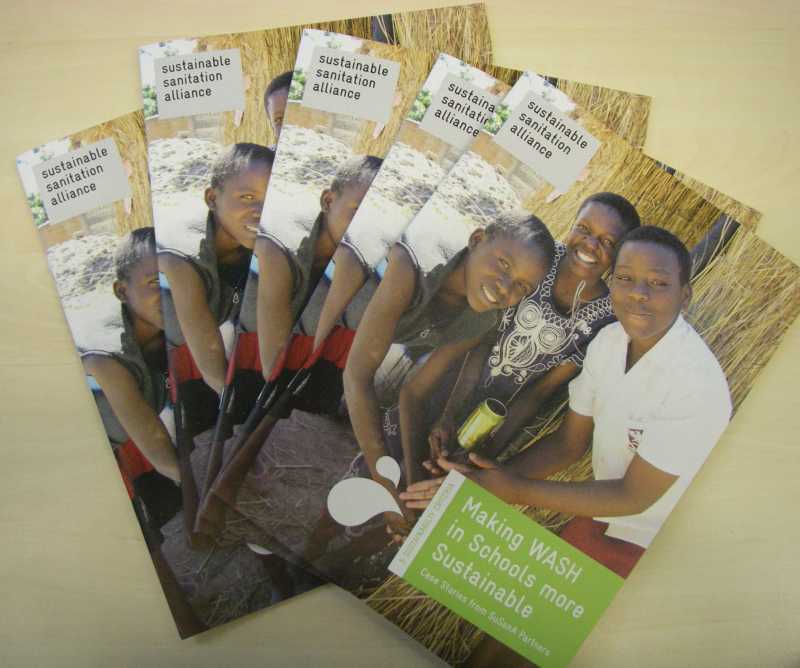
Congratulations to you and your co-authors Claudia, Steffi and Amanda for getting this publication finished! It looks like a very nice piece of work!
Who do you envisage as the main target audience? How could the book best be utilised by people?
Have you thought about taking the content and also transferring it into Wiki pages which will soon be available here on the SuSanA website: www.susana.org/en/resources/wiki#akvopedia:Sanitation Portal?
Would that be fast & easy to do or rather lengthy?
And can people apply to GIZ to receive hardcopies if they need them for specific purposes?
Little hint for everyone: if you want to win a free hardcopy of this publication, you can also take part in our forum user survey (if you haven't done so yet) and write in the last comment field that you wish to get this publication as a prize! Good luck! GIZ has donated 10 hardcopies plus postage for this purpose. As we have in total 150 prizes on offer, you should have a good chance of getting one!
The link to the survey is here in this post:
forum.susana.org/forum/categories/10-by-...ver-150-prizes#10353
Or direct link here .
Regards,
Elisabeth
Congratulations to you and your co-authors Claudia, Steffi and Amanda for getting this publication finished! It looks like a very nice piece of work!
Who do you envisage as the main target audience? How could the book best be utilised by people?
Have you thought about taking the content and also transferring it into Wiki pages which will soon be available here on the SuSanA website: www.susana.org/en/resources/wiki#akvopedia:Sanitation Portal?
Would that be fast & easy to do or rather lengthy?
And can people apply to GIZ to receive hardcopies if they need them for specific purposes?
Little hint for everyone: if you want to win a free hardcopy of this publication, you can also take part in our forum user survey (if you haven't done so yet) and write in the last comment field that you wish to get this publication as a prize! Good luck! GIZ has donated 10 hardcopies plus postage for this purpose. As we have in total 150 prizes on offer, you should have a good chance of getting one!
The link to the survey is here in this post:
forum.susana.org/forum/categories/10-by-...ver-150-prizes#10353
Or direct link here .
Regards,
Elisabeth
Dr. Elisabeth von Muench
Freelance consultant on environmental and climate projects
Freelance consultant on environmental and climate projects
The topic has been locked.
- christian.rieck
-
- Moderator
Less- Posts: 118
- Karma: 7
- Likes received: 41
Re: Collecting good case studies of sustainable sanitation in schools and kindergartens from all over the world
Dear all,
Thank you Maren for further stories. I guess there is already a big pile of more projects for sharing!
For the first round I am happy to share with you the link for the 12 case stories of our finalised SuSanA publication "Making WASH in Schools more Sustainable". This discussion thread documents all the contributions along this almost 2 year long process. Thank you to all for this great effort and joint collaboration and especially to Claudia Wendland who is the lead of the working group 7 on schools.
www.susana.org/en/resources/library/details/2077
I am attaching it as well. Any feedback to it is more than welcome.
Best regards,
Christian and the SuSanA secretariat
Thank you Maren for further stories. I guess there is already a big pile of more projects for sharing!
For the first round I am happy to share with you the link for the 12 case stories of our finalised SuSanA publication "Making WASH in Schools more Sustainable". This discussion thread documents all the contributions along this almost 2 year long process. Thank you to all for this great effort and joint collaboration and especially to Claudia Wendland who is the lead of the working group 7 on schools.
www.susana.org/en/resources/library/details/2077
I am attaching it as well. Any feedback to it is more than welcome.
Best regards,
Christian and the SuSanA secretariat
GIZ Uganda
Enhanced Water Security and Sanitation (ENWASS)
Sanitation for Millions
This email address is being protected from spambots. You need JavaScript enabled to view it.
Enhanced Water Security and Sanitation (ENWASS)
Sanitation for Millions
This email address is being protected from spambots. You need JavaScript enabled to view it.
This message has an attachment file.
Please log in or register to see it.
The following user(s) like this post: Elisabeth
You need to login to reply
The topic has been locked.
- MarenH
-
- BORDA communication management and research project coordination Indonesia/Vietnam.Currently working in Southeast Asia and Germany on topics related to the enabling environment for decentralized sanitation services.
Less- Posts: 5
- Karma: 1
- Likes received: 3
Re: Collecting good case studies of sustainable sanitation in schools and kindergartens from all over the world
Dear all,
BORDA is doing school projects mainly in Afghanistan and Cambodia, but also in other countries in Asia and Africa. Maybe I can get some material from the country offices.
For further information please check www.escambodia.org/ and www.borda-afg.org
Kind regards,
Maren
BORDA is doing school projects mainly in Afghanistan and Cambodia, but also in other countries in Asia and Africa. Maybe I can get some material from the country offices.
For further information please check www.escambodia.org/ and www.borda-afg.org
Kind regards,
Maren
Maren Heuvels
Research & Communication
Bremen Overseas Research and Development Association - BORDA
Fahrenheitstraße 9
28359 Bremen
Germany
E-Mail: This email address is being protected from spambots. You need JavaScript enabled to view it.
Twitter: @Maren_BORDA
Facebook: borda.bremen
Research & Communication
Bremen Overseas Research and Development Association - BORDA
Fahrenheitstraße 9
28359 Bremen
Germany
E-Mail: This email address is being protected from spambots. You need JavaScript enabled to view it.
Twitter: @Maren_BORDA
Facebook: borda.bremen
The topic has been locked.
Re: Collecting good case studies of sustainable sanitation in schools and kindergartens from all over the world
Dear WASH in Schools Fans,
I am glad to announce the publication of the compiled WASH in Schools Stories. It will be launched in September during the SuSanA meeting in Stockholm.
We have selected 12 stories from all the input submitted by many members and partners. There were a number of more worth stories to share and we look forward to publish a second collection of stories which we could not include in this first round.
Best regards
Claudia
I am glad to announce the publication of the compiled WASH in Schools Stories. It will be launched in September during the SuSanA meeting in Stockholm.
We have selected 12 stories from all the input submitted by many members and partners. There were a number of more worth stories to share and we look forward to publish a second collection of stories which we could not include in this first round.
Best regards
Claudia
Claudia Wendland
Water and Sanitation Specialist
HAMBURG WASSER
This email address is being protected from spambots. You need JavaScript enabled to view it.
www.hamburgwasser.de
Water and Sanitation Specialist
HAMBURG WASSER
This email address is being protected from spambots. You need JavaScript enabled to view it.
www.hamburgwasser.de
The topic has been locked.
- christian.rieck
-
- Moderator
Less- Posts: 118
- Karma: 7
- Likes received: 41
Re: Compiling SuSanA school sanitation success stories in a publication
Dear Thilde,
Thanks for offering to contribute to the publication. It would be great to have a short paragraph of 150 to 200 words on the importance and available evidence of the role of WASH in kindergardens and pre-schools for behaviour change and health protection. There are several organisations involved in early childhood support but I do not know them well.
Cheers
Christian
Thanks for offering to contribute to the publication. It would be great to have a short paragraph of 150 to 200 words on the importance and available evidence of the role of WASH in kindergardens and pre-schools for behaviour change and health protection. There are several organisations involved in early childhood support but I do not know them well.
Cheers
Christian
GIZ Uganda
Enhanced Water Security and Sanitation (ENWASS)
Sanitation for Millions
This email address is being protected from spambots. You need JavaScript enabled to view it.
Enhanced Water Security and Sanitation (ENWASS)
Sanitation for Millions
This email address is being protected from spambots. You need JavaScript enabled to view it.
The topic has been locked.
- roycchr
-
Less
- Posts: 1
- Likes received: 1
Re: [Wg7] Collecting good case studies of sustainable sanitation in schools and kindergartens from all over the world
Children are agents of change – an intervention in Kerala on WASH in Schools
WASH in Schools (Water, Sanitation and Hygiene Education) programme have profound impact on the learning ability of children, especially for girls. In many cases, girls remain vulnerable to dropping out of schools and reluctant to go to schools due to lack of appropriate toilet and handwashing facilities. WASH in Schools (WIS) initiative in Kerala (India) reported to increase girls participation, develops positive hygiene behaviors, offers the opportunity to translates good practices in their families as well as in the community. It was further noted that children are found to be powerful agents of change not only in their homes but also in the community as well.
A total of 200 schools were selected for the direct implementation of this project in eight districts of Kerala. The schools are identified as Government schools as well as aided schools from rural and urban areas in Kerala. Further, 300 schools were also selected in order to convey the messages of “good hygiene practices” by means of other communication methods including distribution of reading materials of WASH in schools like WASH hand-books and work-books, WASH posters, Road shows, TV shows, News-letters, articles, website information, e-mail networks and media reporting.
It was observed that Child-to-Child approach is an effective tool on improving water and sanitation practices through learning. By hygiene-related activity-oriented learning strategy, children become more knowledgeable and develop into agents of change in their community with other children, their families and the community. From the field observation, it was noted that children could educate fellow children and the adults on good practices of WASH related lessons.
In several cases, children act as messengers of “good hygiene practices” in their society to a great extent. Messages of good hygiene practices found to be well accepted by different sections of the society and have prolonged impact on the prevailing hygiene habit of the community. Handwashing with soap is a classical example of message transferred to the community by the awareness-cum-practical training of schoolchildren of higher secondary schools and observed a tremendous impact on the attitude of adults. Community members are also able to understand the dangers of poor sanitation and hygiene environment; and have attained the capacity to overcome the situation with remedial measures.
The knowledge on the prevention and precaution of water-borne and water-related diseases especially dengue fever and hepatitis, reported to be well transferred by school children to their homes as well as to the community. Children here act as “health messengers”, who influenced the adults and other members of the society in order to improve their knowledge and skills on the prevention of such diseases.
For more details:
www.cchrindia.org/Details/Children-are-A...-on-WASH/3JHSOK.aspx
WASH in Schools (Water, Sanitation and Hygiene Education) programme have profound impact on the learning ability of children, especially for girls. In many cases, girls remain vulnerable to dropping out of schools and reluctant to go to schools due to lack of appropriate toilet and handwashing facilities. WASH in Schools (WIS) initiative in Kerala (India) reported to increase girls participation, develops positive hygiene behaviors, offers the opportunity to translates good practices in their families as well as in the community. It was further noted that children are found to be powerful agents of change not only in their homes but also in the community as well.
A total of 200 schools were selected for the direct implementation of this project in eight districts of Kerala. The schools are identified as Government schools as well as aided schools from rural and urban areas in Kerala. Further, 300 schools were also selected in order to convey the messages of “good hygiene practices” by means of other communication methods including distribution of reading materials of WASH in schools like WASH hand-books and work-books, WASH posters, Road shows, TV shows, News-letters, articles, website information, e-mail networks and media reporting.
It was observed that Child-to-Child approach is an effective tool on improving water and sanitation practices through learning. By hygiene-related activity-oriented learning strategy, children become more knowledgeable and develop into agents of change in their community with other children, their families and the community. From the field observation, it was noted that children could educate fellow children and the adults on good practices of WASH related lessons.
In several cases, children act as messengers of “good hygiene practices” in their society to a great extent. Messages of good hygiene practices found to be well accepted by different sections of the society and have prolonged impact on the prevailing hygiene habit of the community. Handwashing with soap is a classical example of message transferred to the community by the awareness-cum-practical training of schoolchildren of higher secondary schools and observed a tremendous impact on the attitude of adults. Community members are also able to understand the dangers of poor sanitation and hygiene environment; and have attained the capacity to overcome the situation with remedial measures.
The knowledge on the prevention and precaution of water-borne and water-related diseases especially dengue fever and hepatitis, reported to be well transferred by school children to their homes as well as to the community. Children here act as “health messengers”, who influenced the adults and other members of the society in order to improve their knowledge and skills on the prevention of such diseases.
For more details:
www.cchrindia.org/Details/Children-are-A...-on-WASH/3JHSOK.aspx
The following user(s) like this post: christian.rieck
You need to login to reply
The topic has been locked.
Re: Compiling SuSanA school sanitation success stories in a publication
Hi Christian,
Of course there are also very specific technical issues on kindergarten sanitation and hygiene that could be highlighted in your publication, including small children friendly designs and very guided handwashing routines for the smallest children.
One strong argument for refocusing on kindergartens is also the very strong evidence base for the health impacts of good sanitation and hygiene on children below 5 yrs - they actually benefit more from WASH interventions compared with older children!
I would really be happy to see a paragraph in your report about the smallest sanitation users:) Give my guidelines for the text and I will try.
Thilde
Of course there are also very specific technical issues on kindergarten sanitation and hygiene that could be highlighted in your publication, including small children friendly designs and very guided handwashing routines for the smallest children.
One strong argument for refocusing on kindergartens is also the very strong evidence base for the health impacts of good sanitation and hygiene on children below 5 yrs - they actually benefit more from WASH interventions compared with older children!
I would really be happy to see a paragraph in your report about the smallest sanitation users:) Give my guidelines for the text and I will try.
Thilde
Thilde Rheinländer,
Researcher with interests in socio-cultural factors in WASH
Researcher with interests in socio-cultural factors in WASH
The topic has been locked.
- christian.rieck
-
- Moderator
Less- Posts: 118
- Karma: 7
- Likes received: 41
Re: Compiling SuSanA school sanitation success stories in a publication
Dear Hilde,
thank you for you valid point on kindergardens, unfortunately the collected stories do not yet include any examples of kindergardens. However it should be part of the strategic thinking and yes its neglection is partly due to kindergardens not belonging to the public school system. I think it is necessary to include a passage on it in the upcoming publication. If you like you can phrase a paragraph on kindergardens that we can incorporate.
Best regards,
Christian
thank you for you valid point on kindergardens, unfortunately the collected stories do not yet include any examples of kindergardens. However it should be part of the strategic thinking and yes its neglection is partly due to kindergardens not belonging to the public school system. I think it is necessary to include a passage on it in the upcoming publication. If you like you can phrase a paragraph on kindergardens that we can incorporate.
Best regards,
Christian
GIZ Uganda
Enhanced Water Security and Sanitation (ENWASS)
Sanitation for Millions
This email address is being protected from spambots. You need JavaScript enabled to view it.
Enhanced Water Security and Sanitation (ENWASS)
Sanitation for Millions
This email address is being protected from spambots. You need JavaScript enabled to view it.
The topic has been locked.
Re: Compiling SuSanA school sanitation success stories in a publication
Dear Forum,
I dont have specific case stories of sustainable solutions - unfortunately. Rather I have seen kindergarten sanitation solutions fail in many countries incl. Vietnam, Ghana, Sri Lanka, and South India.
Some strategic observations from these experiences:
- Kindergartens are enourmously important platforms for sanitation promotion, but are often forgotten as an integral part of School sanitation. In some countries this is due to Kindergartens not belonging to the official school systems. So I am very happy to see kindergartens mentioned specifically and upfront in this endevour!
- Kindergartens or creches are emerging in huge numbers in low income countries, because parents need child care when they attend to their work to secure incomes. Therefore kindergartens are underatken by a wide variety of agencies including commercial companies, faith-based organisations, educational authorities and private filantropics. The quality of child care including health, hygiene and sanitation standards varies wildly since many of these kindergartens do not have to follow government standards for water, sanitation and hygiene.
Woking towards aligning WASH standards for kindergartens and having strong kindergarten WASH policies and guidelines for all types of institutions is a MUST for future work.
I dont have specific case stories of sustainable solutions - unfortunately. Rather I have seen kindergarten sanitation solutions fail in many countries incl. Vietnam, Ghana, Sri Lanka, and South India.
Some strategic observations from these experiences:
- Kindergartens are enourmously important platforms for sanitation promotion, but are often forgotten as an integral part of School sanitation. In some countries this is due to Kindergartens not belonging to the official school systems. So I am very happy to see kindergartens mentioned specifically and upfront in this endevour!
- Kindergartens or creches are emerging in huge numbers in low income countries, because parents need child care when they attend to their work to secure incomes. Therefore kindergartens are underatken by a wide variety of agencies including commercial companies, faith-based organisations, educational authorities and private filantropics. The quality of child care including health, hygiene and sanitation standards varies wildly since many of these kindergartens do not have to follow government standards for water, sanitation and hygiene.
Woking towards aligning WASH standards for kindergartens and having strong kindergarten WASH policies and guidelines for all types of institutions is a MUST for future work.
Thilde Rheinländer,
Researcher with interests in socio-cultural factors in WASH
Researcher with interests in socio-cultural factors in WASH
The following user(s) like this post: Elisabeth
You need to login to reply
The topic has been locked.
- Elisabeth
-
- User is blocked
- Freelance consultant since 2012
Less- Posts: 3372
- Karma: 54
- Likes received: 932
Re: Otji toilets Namibia - Collecting good case studies of sustainable sanitation in schools and kindergartens from all over the world
Dear Jabulani,
Can you please introduce yourself, at least a little bit (e.g. by editing your forum profile, see: forum.susana.org/forum/categories/134-user-profile)?
We have had information about the Otji toilets in Namibia (urine diverting dry toilets) on the forum and in the Susana library before (see links below), although none of them talked specifically about Otji toilets in schools in Namibia or in South America where they also have them (in Ecuador, I think).
Do you have fist-hand information on that which you could share?
Here the links to previous stuff about Otji toilets:
Forum post: forum.susana.org/forum/categories/34-uri...-for-the-otji-toilet
Susana case study:
Kleemann, F., Berdau, S. (2011). Otji toilets for peri-urban informal households - Omaruru, Namibia. Sustainable Sanitation Alliance (SuSanA).
susana.org/lang-en/library?view=ccbktypeitem&type=2&id=1186
Conerence paper from 2012:
Ingle, R., Berdau, S., Kleemann, F., Arndt, P. (2012). What does it take to convince decision makers in Omaruru, Namibia to scale up urine diversion dehydration “Otji toilets”?. 4th International Dry Toilet Conference, Tampere, Finland.
susana.org/lang-en/library?view=ccbktypeitem&type=2&id=1608
Further documents about Otji toilets in Susana library:
www.susana.org/library?search=otji
Regards,
Elisabeth
Can you please introduce yourself, at least a little bit (e.g. by editing your forum profile, see: forum.susana.org/forum/categories/134-user-profile)?
We have had information about the Otji toilets in Namibia (urine diverting dry toilets) on the forum and in the Susana library before (see links below), although none of them talked specifically about Otji toilets in schools in Namibia or in South America where they also have them (in Ecuador, I think).
Do you have fist-hand information on that which you could share?
Here the links to previous stuff about Otji toilets:
Forum post: forum.susana.org/forum/categories/34-uri...-for-the-otji-toilet
Susana case study:
Kleemann, F., Berdau, S. (2011). Otji toilets for peri-urban informal households - Omaruru, Namibia. Sustainable Sanitation Alliance (SuSanA).
susana.org/lang-en/library?view=ccbktypeitem&type=2&id=1186
Conerence paper from 2012:
Ingle, R., Berdau, S., Kleemann, F., Arndt, P. (2012). What does it take to convince decision makers in Omaruru, Namibia to scale up urine diversion dehydration “Otji toilets”?. 4th International Dry Toilet Conference, Tampere, Finland.
susana.org/lang-en/library?view=ccbktypeitem&type=2&id=1608
Further documents about Otji toilets in Susana library:
www.susana.org/library?search=otji
Regards,
Elisabeth
Dr. Elisabeth von Muench
Freelance consultant on environmental and climate projects
Freelance consultant on environmental and climate projects
The topic has been locked.
Share this thread:
- Forum
- categories
- SuSanA working groups and regional chapters
- Working Group 7 (Sustainable WASH in Institutions and Gender Equality (Leave No One Behind – in communities, schools and other institutions)
- Collecting good case studies of sustainable sanitation in schools and kindergartens from all over the world
Recently active users. Who else has been active?
Time to create page: 0.155 seconds